Horror at the Controls: Part 1 — Jaws
- Horror at the Controls
- Horror films
- Horror games
- NES
- PlayStation
- Jaws
- Friday the 13th
- Predator
· Aaron Lehnen · 10 min read
From summer blockbuster to playable predator.
One shark. Four theatrical films. Decades of games trying to decide whether you should fear the water—or become the reason everyone else does.
That is the strange journey of Jaws. Spielberg's film frightened audiences by withholding its monster. Games, meanwhile, need something for players to do. Hunt the shark? Explore the seabed? Protect swimmers? Eat absolutely everything?
The answers tell us almost as much about game design as they do about Hollywood's most famous great white.
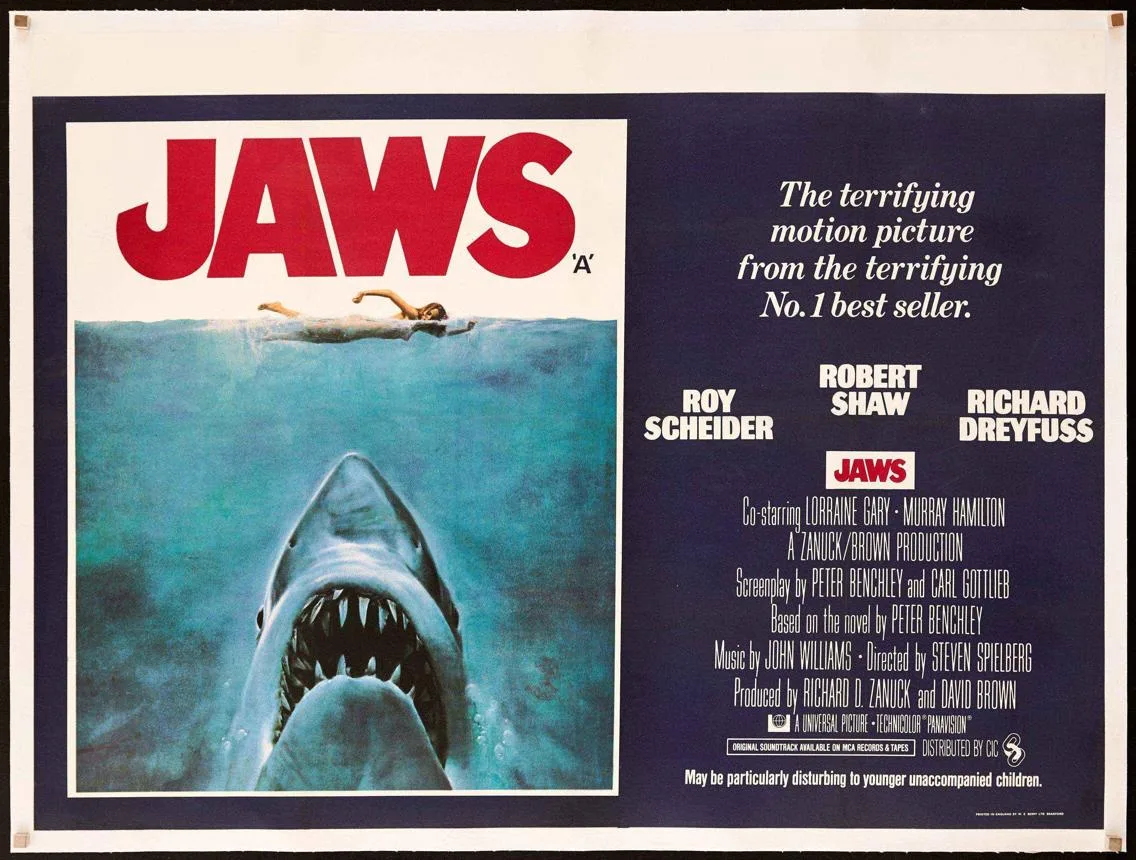
The shark you couldn't see
Released in 1975, Steven Spielberg's adaptation of Peter Benchley's novel sent police chief Martin Brody, marine biologist Matt Hooper, and shark hunter Quint after a great white terrorizing Amity Island.
Its premise was simple. Its execution changed the summer movie season.
The mechanical shark's production troubles helped encourage an approach that became the film's great strength: suggestion. An underwater viewpoint, an empty stretch of ocean, a disturbance nobody can quite explain. The audience supplies the monster long before it gets a proper look at it.
John Williams' accelerating two-note motif does much of that work. It turns anticipation into a physical sensation. You hear danger before you see it, and suddenly perfectly ordinary water becomes a terrible place to put your legs.
That creates a difficult assignment for a game developer. A film can make you watch an empty ocean. A game has to make searching it interesting.
The sequels progressively loosened the original's restraint. Jaws 2 returned to Amity in 1978; Jaws 3-D moved into a marine theme park in 1983; Jaws: The Revenge gave the shark a remarkably personal interest in the Brody family in 1987. These increasingly extravagant scenarios supplied game designers with more than one kind of shark story.
Jaws on NES: shells, upgrades, and an awkward showdown
1987 · Nintendo Entertainment System · Published by LJN
The NES Jaws is remembered as an odd little licensed game. It deserves a second look, provided you don't expect a scene-by-scene adaptation of Spielberg's film.
An overhead ocean map connects underwater combat, visits to ports, bonus rounds, and a final encounter with the shark. The main loop is straightforward: collect conch shells, exchange them for greater power, survive another expedition, and return better equipped.
In other words, Amity Island has become a tiny monster-hunting economy.
The ports matter because upgrades give repeated trips a purpose. The ocean is no longer just empty space between cinematic moments. It is where you gather the resources needed to survive the next confrontation. That is a sensible way to build a playable adventure from a relatively small amount of material.
The problem is that much of the immediate danger comes from everything except Jaws. Jellyfish, rays, and other creatures keep the diver busy. A routine shell-gathering trip can be interrupted by the shark, but ordinary enemies dominate a great deal of the action.
This is where the adaptation begins to pull in two directions. On screen, the shark makes the whole ocean frightening. On NES, the ocean is already packed with things to shoot, leaving its famous resident to compete for attention.
There is still tension in meeting Jaws before you feel ready. You have invested time in upgrades; now the ultimate objective has arrived early, and retreat may be more sensible than heroism. For a modest arcade adventure, that is a worthwhile idea.
The game also switches activities. A miniature submarine offers another way to tackle the underwater sections, while a seaplane bonus round replaces diving with bombing targets. These changes help break up the repetition, even if the variety feels more like a collection of arcade scenes than a coherent shark thriller.
The finale changes the rules
Weakening Jaws is only preparation for the ending. The final scene asks you to use a strobe and position the boat for a ramming attack. After learning to survive underwater encounters and improve your weapons, you must suddenly master a different timing challenge.
That shift is a large part of the game's peculiar reputation. Progress does not guarantee that you understand how to finish. You can arrive armed, experienced, and thoroughly tired of jellyfish, then discover the last few seconds require a skill the rest of the adventure barely taught you.
The boat attack also links the game more closely to The Revenge than to the compressed-air explosion in the original film. This isn't simply Spielberg's Jaws squeezed into a cartridge; it draws from a franchise that had already become stranger.
The music makes a similar compromise. Recognizable cinematic identity helps establish the license, but repeated gameplay needs short pieces that can accompany exploration and action. The mood shifts from waiting for something dreadful to happen toward keeping an arcade adventure moving.
So, is it a bad game? Its repetition and abrupt finale deserve criticism. But the progression loop, changing perspectives, and recurring predator give it an identity beyond its box art. The interesting question is how much of Jaws survives those decisions.
The 1989 computer game: equipment before courage
The home-computer history needs a little care: a shared title does not mean every release is the same game on different hardware.
The Intelligent Design version associated with Screen 7 takes an exploration-led approach. Its manual describes a team retrieving four weapon sections and special ammunition from underwater caverns before attempting to kill the shark. Finding the necessary equipment becomes the central task.
This is a different answer to the adaptation problem. Preparation matters more than repeatedly farming shells. The player must investigate a hostile environment before earning a confrontation with the threat that brought everyone there.
It also creates an interesting limitation. Much of the adventure again happens away from the shark itself. That can make the final encounter feel important, but it risks turning the film's ever-present menace into a reward for finishing the rest of the game.
The distinction is subtle but revealing. Jaws is frightening because the shark might be nearby. A game can become less frightening if the player learns that the shark is essentially waiting behind the final objective.
Jaws Unleashed: you're going to need fewer swimmers
2006 · PlayStation 2, Xbox, Windows · Appaloosa Interactive / Majesco
Then someone asked the obvious, terrible question: what if we gave the player the shark?
Jaws Unleashed reverses the relationship completely. Instead of protecting vulnerable people from an apex predator, you explore underwater environments, attack prey, damage boats, and cause the kind of destruction a tourism board would prefer not to mention.
The film makes humans helpless. The game makes helpless humans part of your itinerary.
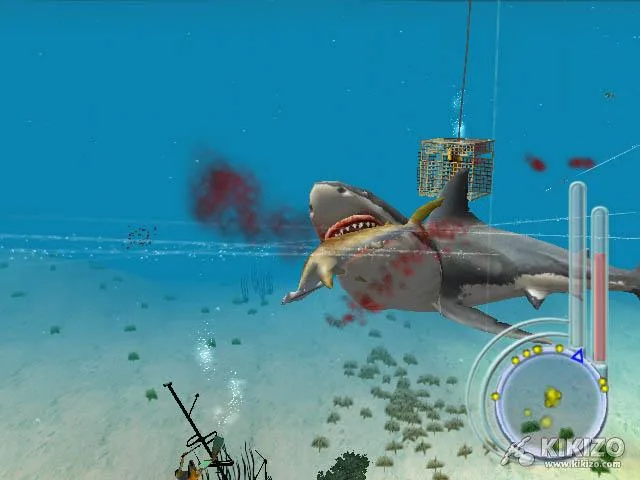
This is an appealing fantasy because movement through the water becomes enjoyable in itself. You are not merely surviving a dangerous place; you are discovering what you can do within it. A new ability changes which targets are manageable and which parts of the environment invite investigation.
The premise also gives the designers a new problem. If you are already the ocean's most terrifying predator, what is supposed to frighten—or at least challenge—you?
The answer is escalation. Larger aquatic opponents, increasingly elaborate human obstacles, and situations that stretch the logic of an animal protagonist. A marine theme-park setting recalls Jaws 3-D, while encounters with other formidable creatures make the game feel like a playable creature feature.
Sometimes the shark even becomes a puzzle solver. Using a human body to operate a card reader is wonderfully ridiculous: an animal acting with the practical reasoning of an action hero, because the player needs a door to open.
That contradiction is part of the game's personality. It wants the shark to behave like a destructive force of nature, but missions require the planning and problem-solving of someone holding a controller.
The controls, technical roughness, and uneven objectives can undermine the fun. Still, there is a strong idea underneath them. Unleashed does not reproduce the original film's fear. It offers the freedom to become what caused it.
That is why it remains more memorable than a routine licensed action game. Its central transformation is clear, immediate, and difficult to confuse with anything else.
Smaller screens, bigger monsters
The franchise also explored mobile games, including Jaws 3D, touchscreen Jaws, and Jaws Revenge. These releases adapted the license to different devices and shorter sessions, often favoring quick attacks and straightforward progression over a sustained atmosphere of dread.
This is where historical coverage can become a shopping list, so the important point is the change in emphasis: the shark becomes something you improve and send into another round, rather than something you spend an entire film hoping to avoid.
Jaws: Ultimate Predator continued that escalation on Wii and Nintendo 3DS in 2011. The versions should not be treated as identical games. Their presentation and structure differ, even though both invite you to take control of the shark.
The Wii game's more extravagant enemies push particularly far into monster-movie territory. At that point, judging everything against the plausibility of Spielberg's original misses the experience being offered. The more useful question is whether the exaggerated encounters are enjoyable to control.
A brief detour into Universal Studios Theme Parks Adventure on GameCube offers another interpretation: adapt the attraction, rather than the film's plot. The shark becomes part of an interactive version of a theme-park visit.
Across these experiments, the license is surprisingly flexible. The ocean can be a maze, an arena, a playground, or a familiar stop on a virtual holiday.
Pinball and a return to the original cartridge
Not every adaptation needs a free-roaming ocean. Zen Studios' Jaws table arrived with Universal Classics Pinball in 2017. Stern followed with physical Jaws machines in 2024, translating familiar characters and shark encounters into targets, mechanisms, and repeatable objectives.
Pinball is an especially interesting compromise. It cannot recreate a believable shark hunt, but it can control anticipation: a target moves, a mechanism activates, a familiar cue announces danger. The film's identity becomes a rhythm of preparation and payoff.
In 2026, JAWS: Retro Edition returned to the NES game's foundation. Nintendo lists its Switch release as February 13, 2026. Alongside the retro experience, the package includes an expanded adventure, new objectives and equipment, and modern conveniences such as saving and rewind.
That matters for more than preservation. The old game's exploration-and-upgrade loop had room to grow. Revisiting it allows designers to develop those ideas instead of treating the original as an embarrassing artifact to be filed away.
The franchise's gaming history loops back on itself: an odd adaptation inspired partly by the fourth film becomes the basis for a modern package that reaches across all four.
What would a frightening Jaws game look like?
These games reveal three appealing roles: the hunter, the vulnerable explorer, and the monster. Each can make a good game. Only some naturally create the uncertainty that made the film frightening.
Imagine managing reports of missing swimmers, checking disturbances with limited equipment, and deciding when a beach is too dangerous to leave open. A shadow might be harmless. A quiet dive might not be. The shark's absence would need to mean something besides a delayed boss fight.
That is a design possibility, rather than a claim that the existing games should all have pursued it. Unleashed succeeds at a different fantasy. Pinball succeeds by compressing familiar moments into an immediately readable challenge. The NES game finds a surprisingly durable resource loop inside a very small adventure.
What links them is the change in responsibility. Film audiences can shout at someone to get out of the water. Players have to decide whether to enter it, what to take, and how long to stay.
Or they can become the reason everyone else is screaming.
Next: Part 2 — Friday the 13th: Jason Voorhees and the Evolution of Interactive Slasher Horror.
Sources and image credits
- AFI's Jaws film entry: film history and production context.
- Original NES Jaws instruction booklet: progression, equipment, and final-scene controls.
- 1989 computer Jaws manual, preserved by CPC-Power: weapon recovery and credits; this section describes that version specifically.
- Majesco's 2007 Jaws Unleashed announcement: publisher record of the console release.
- Zen Studios on the Universal Classics launch and Stern's 2024 announcement.
- Nintendo's JAWS: Retro Edition listing: release date and package features.
Images accompany discussion of the works depicted; their original rights remain with the respective owners. Poster and screenshot were supplied with the original manuscript; captions identify the depicted work and credited source.
Keep the horror playing
Listen after dark
If you’d like to keep the atmosphere going, here’s Under The Covers: 12 Nights of Horror—my arrangements of themes from Halloween, Friday the 13th, Jaws, The Exorcist, Silent Hill, and more.