Horror at the Controls: Part 2 — Friday the 13th
- Horror at the Controls
- Horror films
- Horror games
- NES
- Jaws
- Friday the 13th
- A Nightmare on Elm Street
· Aaron Lehnen · 11 min read
Jason Voorhees and the evolution of interactive slasher horror.
You have found the battery. Someone else has the keys. The car is almost repaired, the woods have gone quiet, and your friend has just asked a question nobody wants to answer: where is Jason?
That is the opportunity a Friday the 13th game offers. A movie makes you watch people make terrible decisions. A game gives you the chance to make those decisions yourself—with considerably less confidence once the footsteps start.
In our Jaws feature, the monster gradually became something players could control. Jason followed a similarly strange path, but his best adaptations found a different source of fear: other people, incomplete information, and someone you cannot reliably predict.
Before the hockey mask
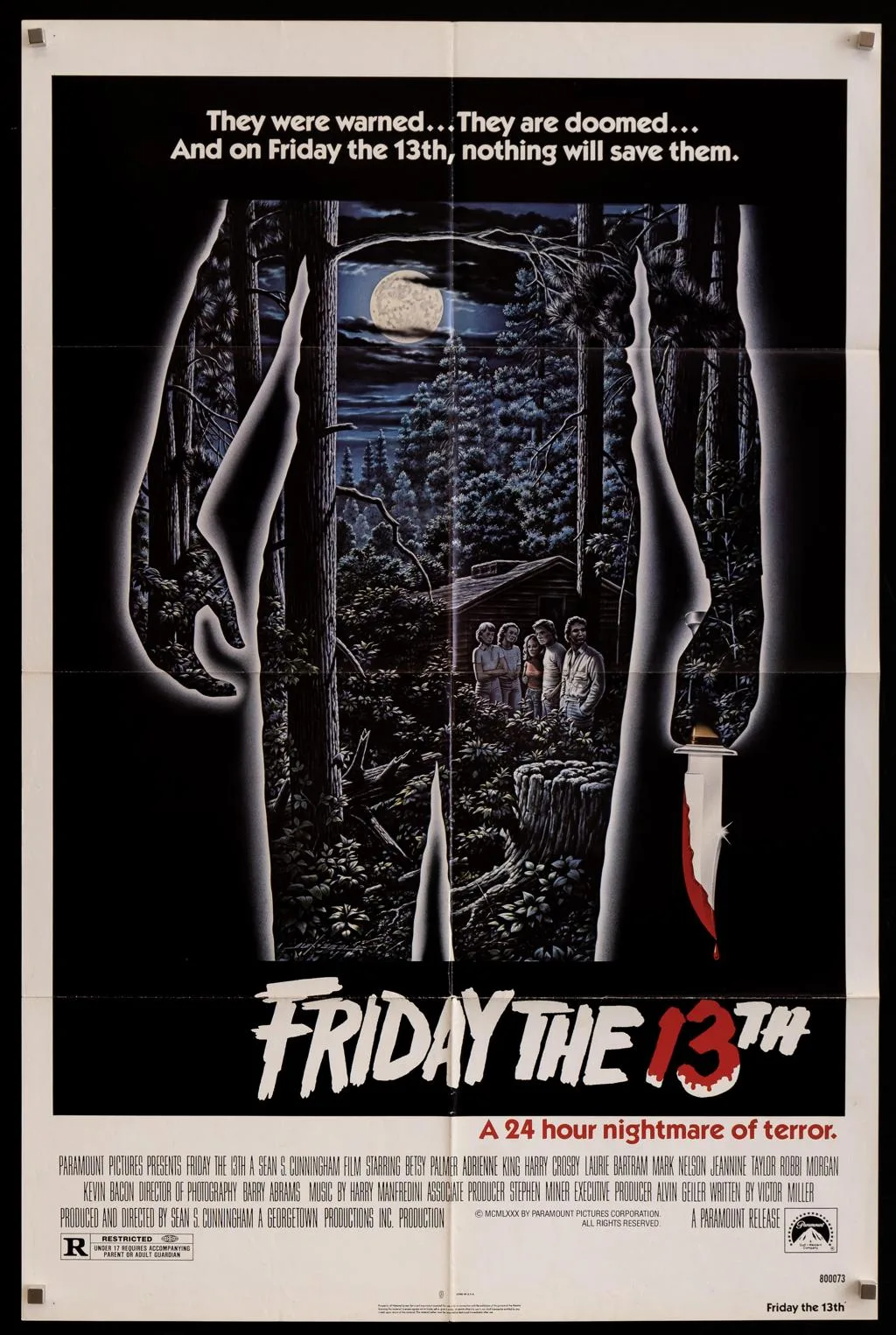
Sean S. Cunningham's Friday the 13th arrived in 1980, sending young counselors to reopen a summer camp with a terrible history. Jason Voorhees had supposedly drowned at Crystal Lake. Now someone was murdering the people who returned.
The detail worth remembering is that adult Jason is not the original film's killer. His mother, Pamela Voorhees, is. Jason becomes the principal threat in Part 2, and the hockey mask arrives in Part III.
That progression matters because the games inherit several different kinds of horror. The first film offers a murder mystery. Later installments offer a recognizable stalker. The increasingly supernatural Jason offers a monster who can survive punishment that would end an ordinary villain's career.
Each version suggests different mechanics. Conceal the killer's identity, make the player responsible for people scattered around a camp, or put an apparently unstoppable hunter under someone else's control. The history of the games is partly a history of choosing between those possibilities.
1985: the killer might be standing beside you
Friday the 13th: The Computer Game · Domark · Commodore 64, ZX Spectrum, Amstrad CPC
The early computer adaptation makes an unexpectedly interesting choice: Jason can blend in with the other characters. The player explores a camp, searches for weapons, and tries to identify the murderer before too many people die.
For a game of its period, that premise is more adventurous than simply putting a masked enemy at the end of a level. A character wandering nearby is not automatically a safe companion. The camp is a place to investigate, and every delay creates the possibility that something dreadful is happening elsewhere.
This is a rough approximation of slasher-film uncertainty. The player does not need a beautifully rendered forest to understand the problem. Someone is missing. Someone else is suspicious. Your weapon does not answer the question of whom to trust.
The execution is crude, and the computer versions differ in their presentation. Navigation, movement, and combat can make an intriguing idea harder to enjoy than it ought to be. Still, it deserves credit for treating the license as a situation to simulate rather than a sequence of images to copy.
Its shock-oriented presentation also points toward something the later games would understand: sound and interruption can do more than a detailed monster model. An unexpected warning makes an apparently routine moment feel unsafe.
That is a useful distinction when discussing early horror. Technical limitations did not prevent developers from recognizing the right kind of fear. They often made it difficult to turn that insight into a satisfying game.
1989: six counselors and too many emergencies
Friday the 13th · Nintendo Entertainment System · Atlus / LJN
The NES game is notorious, and not without reason. Crystal Lake can be confusing, the early weapons are discouraging, and the route to victory is not immediately obvious. But underneath that reputation is a remarkably ambitious survival scenario.
You can switch between six counselors: George, Mark, Paul, Laura, Debbie, and Crissy. Their abilities differ, and keeping them alive matters. Children are sheltered around the lake, Jason can attack them, and your current exploration plan can be interrupted by an emergency somewhere else.
That is more complicated than walking right until a boss appears.
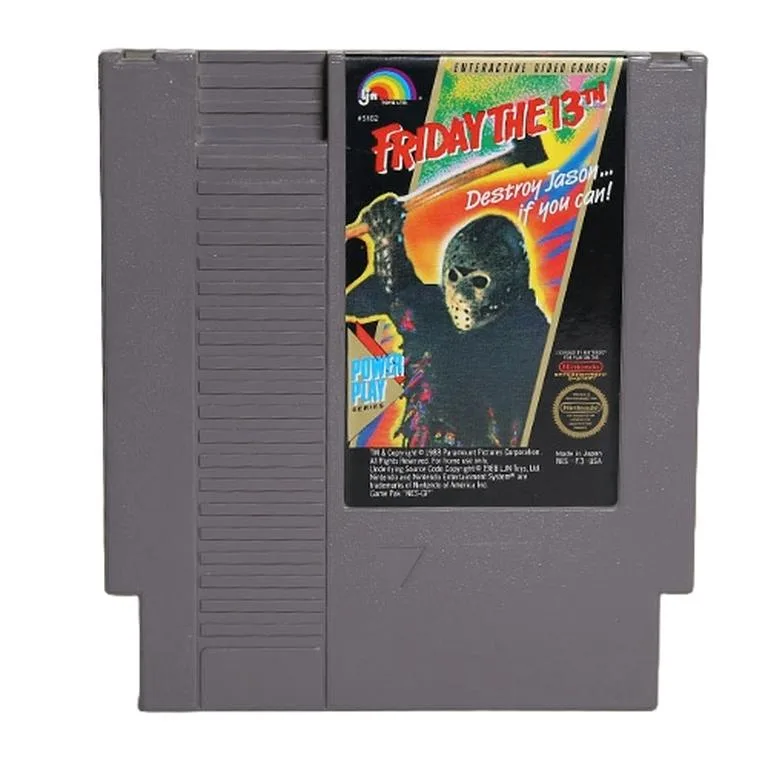
The alarm is the game's most effective idea. You may be searching for a better weapon when someone else needs help. Do you abandon what you are doing? Which surviving counselor can get there fastest? Will arriving poorly equipped simply add another victim?
The problem is not just Jason's strength. It is the fact that you cannot attend to every danger at once.
That pressure creates a recognizably cinematic situation: the audience knows people are in danger in different places, but the person currently on screen cannot rescue everyone. The game hands that helplessness to the player.
Unfortunately, its geography often fights the idea. Branching routes, forests, caves, and changing perspectives make urgent travel less intuitive than it should be. A rescue can fail because you have misunderstood the route rather than because you made an interesting tactical choice.
There is a valuable game inside that frustration. The execution simply makes it harder to see.
Why is Crystal Lake full of zombies?
Ordinary travel brings zombies, wolves, bats, and other obstacles. These give the player something to fight between encounters with Jason, but they also change the atmosphere. The camp begins to resemble a supernatural action game's obstacle course.
The compromise is understandable. A recurring killer alone does not automatically provide enough moment-to-moment activity for this kind of NES adventure. Regular enemies fill the gaps, use up health, and complicate movement.
But every zombie also draws attention away from the individual threat that defines the films. It is the same adaptation problem we saw with the jellyfish in Jaws: making the environment busy can make its famous monster less special.
Then there is Pamela's head.
The original instruction booklet explicitly describes Jason's mother's ghostly, severed head guarding his hidden weapons. So this is not merely a rumor that grew around a strange boss sprite. It is an intentional, wonderfully excessive transformation of franchise mythology into a game encounter.
A horror film's backstory becomes a secret room, a supernatural guardian, and a reward for the player willing to find it. It is absurd, but it is also unmistakably game design.
Three days with a purple Jason
Jason repeatedly interrupts the adventure. Cabin battles change the perspective, requiring the player to dodge and retaliate. Better weapons make a difference, but surviving one confrontation does not settle matters. The game stretches the threat across three increasingly difficult days.
His purple-and-blue appearance is another memorable departure from the films. Whatever the exact reason behind that palette, it became a distinctive version of the character. There is no need to turn an appealing fan theory about the colors into a documented production fact.
The music adds another layer of identity. Short, recurring phrases help make the camp feel unsettled, while sudden danger changes the player's priorities. It is a different language from the films' orchestral suspense, but it can still create unease.
The NES adaptation deserves neither automatic dismissal nor a free pass. It has confusing systems and a strong underlying idea: an entire camp remains under threat while you are busy doing something else.
2017: another player becomes the nightmare
Friday the 13th: The Game · IllFonic / Gun Media
Released on May 26, 2017, the multiplayer game finally turns the slasher scenario into a contest between people. One player controls Jason; up to seven others attempt to survive as counselors.
That asymmetry is the essential design decision. The counselors need equipment, transport, cooperation, and time. Jason needs to stop them obtaining those things—or catch them before their plans come together.
Now a battery can be more interesting than a weapon. It represents a possible escape, but only if somebody finds the rest of the necessary equipment and the group manages to coordinate. A seemingly minor discovery changes what everyone wants to do next.
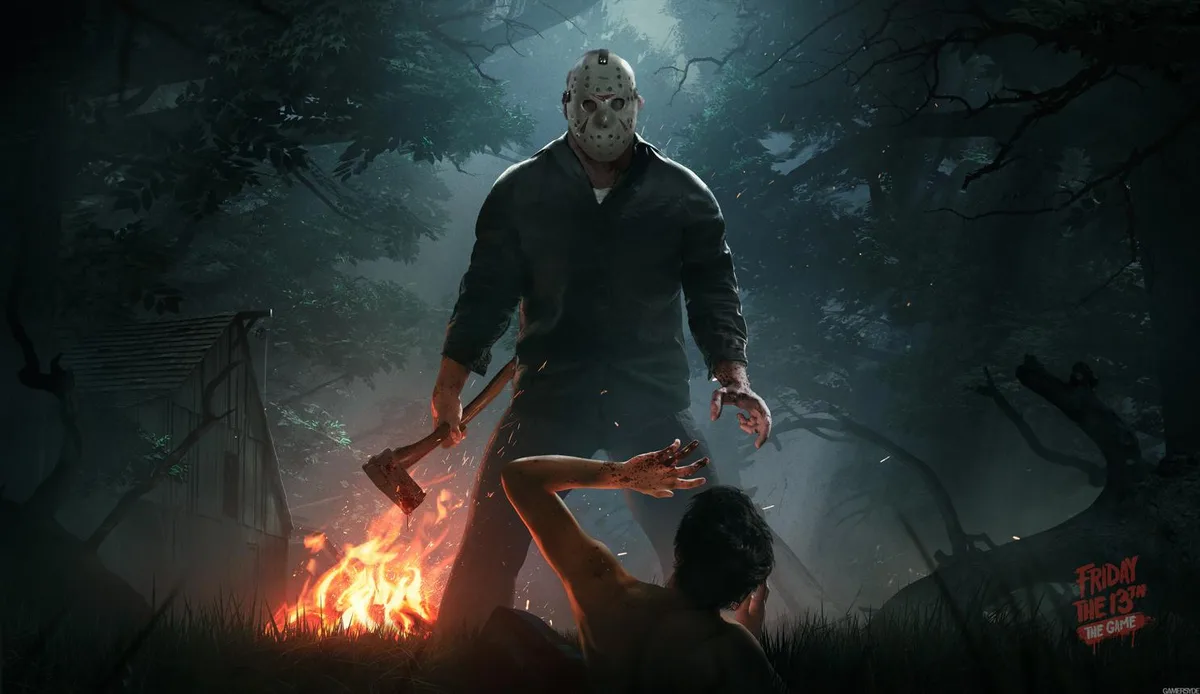
The best moments are often the ones before an attack. Someone disappears while searching a cabin. A useful item turns out to be in the wrong person's hands. A friend panics and leads the killer toward the group. The car is nearly ready, but “nearly” becomes an unbearably long distance from “moving.”
These incidents do not all require a scripted sequence. They emerge because players have incomplete information and different priorities. Helping another counselor can be generous, sensible, disastrous, or all three in succession.
Jason, meanwhile, is not restricted to the predictable behavior of an ordinary boss. His abilities let him track and pursue, and different incarnations offer different strengths and weaknesses. The person controlling him can notice a pattern, exploit a mistake, or choose a target the survivors hoped would be overlooked.
That makes uncertainty active. Players are frightened not only by what Jason can do, but by what another person might decide to do with him.
The game's connection to the films also extends beyond the mask. Kane Hodder's performance work and Harry Manfredini's music helped give the project the physical and auditory identity fans expected. Those details matter because an authentic silhouette alone cannot carry an entire evening of suspense.
Launch problems, bugs, and awkward moments are part of its history too. Still, the core idea is unusually well matched to the license: let a group of people create their own disastrous night at Crystal Lake.
The future that licensing interrupted
In June 2018, Gun announced that the rights dispute surrounding the franchise prevented further content additions. Its statement specifically ruled out material including Uber Jason and the Grendel map inspired by Jason X. Maintenance and the end of new content were separate issues.
Later, the publisher's store notice set December 31, 2023 as the end of sales and promised existing owners functionality through at least December 31, 2024. That wording should not be rewritten as proof that every feature automatically disappeared at midnight. The narrower, important fact is that the commercial life and supported future of this particular game had become finite.
It changes how we think about preservation. An old cartridge can remain playable after the business agreement behind it expires. A multiplayer experience also depends on infrastructure, compatible systems, and other people being able to join.
Keeping a copy of the software is therefore not always the same as keeping the experience. For a game whose greatest achievement was unpredictable interaction between players, that is a substantial difference.
2018: Jason discovers logic puzzles
Friday the 13th: Killer Puzzle, from Blue Wizard Digital, finds an entirely different use for the character. Jason slides around compact environments, and the player plans a route through obstacles to reach victims.
The important question is no longer “Where is the killer?” You are the killer, and the problem is whether you have thought three moves ahead.
Its cartoon presentation and dark humor make the violence deliberately theatrical. Pamela's disembodied head returns as a guide, giving the franchise a second remarkably memorable use for an already unlikely visual idea.
The format works because it commits to its own rules. Jason's recognizable identity supplies the joke and atmosphere; the puzzle supplies the challenge. It does not need to reproduce the films' pacing to justify the adaptation.
Licensing still caught up with it. Blue Wizard announced that sales would end on January 23, 2023 after it could not renew the license, while saying existing purchasers would retain access to their paid content. That is a different situation from assuming every delisted game instantly becomes unplayable.
Jason's 2015 guest appearance in Mortal Kombat X demonstrates another possibility: translate his relentless physical presence into a fighting-game moveset. This is a character study through mechanics rather than a recreation of Crystal Lake. These examples are selected adaptations and crossovers, rather than a claim to catalog every Jason appearance.
What finally made Crystal Lake frightening?
The most interesting thread runs from the disguised killer in the computer game, through the NES alarm, to the 2017 multiplayer chase. Each makes the player aware of danger they cannot completely observe or control.
The NES game's ambition deserves recognition precisely because its problems are so visible. It tries to make other people's survival matter while you are elsewhere. The multiplayer game finds a stronger way to realize that pressure by giving those other people—and the killer—decisions of their own.
The horror does not depend on a body count. It depends on the gap between what you know, what your friends know, and what somebody in a hockey mask is about to do.
That is the difference between adding Jason to a game and making the player feel trapped in one of his films.
Next in the series: Part 3 — A Nightmare on Elm Street. Freddy's dream worlds give us a different problem: what happens when even the environment cannot be trusted?
Sources and image credits
- LJN's original NES instruction booklet, transcribed at World of Nintendo: counselor names, camp layout, threatened children, and Pamela's head.
- The publisher's Steam listing: release date, developer/publisher, multiplayer premise, and the sales/functionality notice. The notice promises functionality through at least December 31, 2024; it does not establish the condition of every mode afterward.
- Gun's June 11, 2018 end-of-content announcement: canceled additions and the distinction between content development and maintenance.
- Blue Wizard's winding-down announcement: January 2023 delisting and the developer's statement about existing purchasers.
- Official Jason Universe: current franchise news. Future projects and guest appearances are separate from the specific releases examined here.
Poster, cartridge photograph, and promotional artwork were supplied with the original manuscript. Captions identify their credited sources; rights remain with the respective owners. This feature discusses film and game spoilers.
Keep the horror playing
Listen after dark
If you’d like to keep the atmosphere going, here’s Under The Covers: 12 Nights of Horror—my arrangements of themes from Halloween, Friday the 13th, Jaws, The Exorcist, Silent Hill, and more.