Horror at the Controls: Part 3 — A Nightmare on Elm Street
- Horror at the Controls
- Horror films
- Horror games
- NES
- Friday the 13th
- A Nightmare on Elm Street
· Aaron Lehnen · 9 min read
When sleep became the enemy.
A locked door might keep a slasher outside. A boat might carry you away from a shark. Freddy Krueger presents a less convenient problem: sooner or later, everyone has to sleep.
That makes A Nightmare on Elm Street unusually promising material for games. Dreams can change the rules without warning. A familiar room can become a trap, a harmless object can turn hostile, and the player can never be entirely sure which version of reality they are exploring.
The surprise is that Freddy's early games sometimes made entering the nightmare an advantage. Sleep brought danger, but it also brought powers. The place you were supposed to avoid became the place where you could fight back.
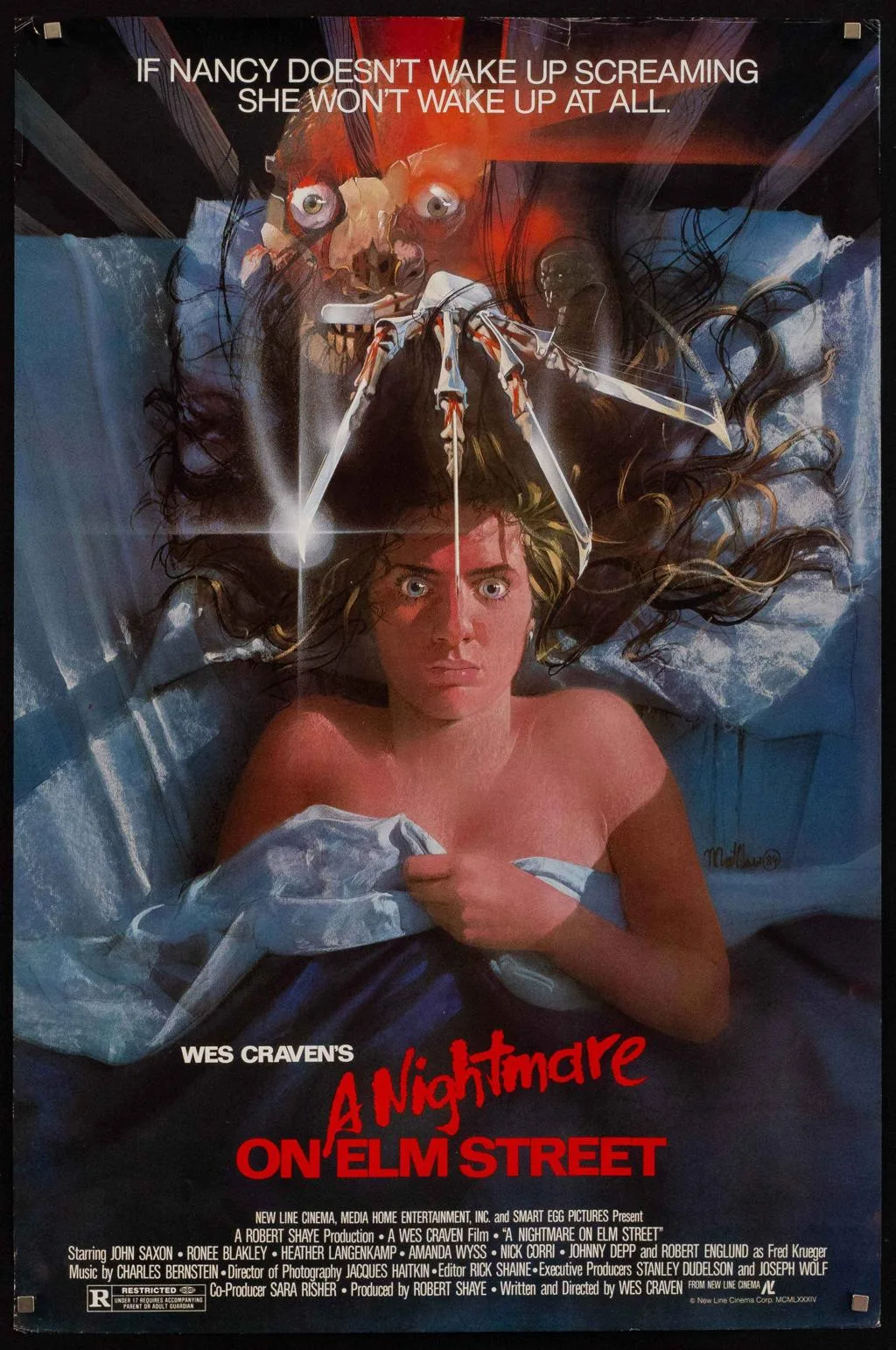
The villain who could change the room
Wes Craven's 1984 film follows Nancy Thompson and her friends as a burned man with a bladed glove invades their dreams. Robert Englund's Freddy is more than a pursuer. He can manipulate the environment, turn personal fears into attacks, and undermine the reassuring distinction between waking up and escaping.
The film's electronic atmosphere and sinister counting rhyme make that uncertainty audible. You do not need to see the glove to know which nightmare you have entered.
The sequels expanded the possibilities. Dream Warriors gave its young characters extraordinary abilities while asleep; The Dream Master added still more elaborate confrontations. Those developments offered designers an appealing contradiction: Freddy owns the dream world, but the people trapped there need not be defenseless.
For a film audience, that changes what a victim might do. For a player, it suggests an entire system of movement, transformation, and risk.
Westwood's 1989 game: go inside to gain your powers
Before Rare's Nintendo adaptation, Westwood Associates developed a computer adventure published by Monarch Software. Its overhead viewpoint and exploration-led structure make it a different interpretation, rather than an early version of the NES game.
The original manual describes a choice of characters, the search for Freddy's house, endangered friends, and a nightmare realm in which the player's special abilities become available. The objective is not simply to walk through a level and punch a familiar movie villain.
You have to enter the place where he is strongest.
That decision captures the logic of Dream Warriors. The nightmare is a source of danger and a source of possibility. Choosing a character means choosing how to cope with the world beyond the ordinary neighborhood.
The approach also gives exploration a purpose. Objects, routes, and threats matter because the player is trying to understand a hostile place, not merely admire its resemblance to a film set. Its older computer presentation can be awkward to navigate, but the underlying question remains attractive: how much danger will you accept to become capable of confronting it?
This is an important distinction in Freddy's history. The license could support an adventure built around investigation and special abilities, as well as the more immediately recognizable platform game that followed.
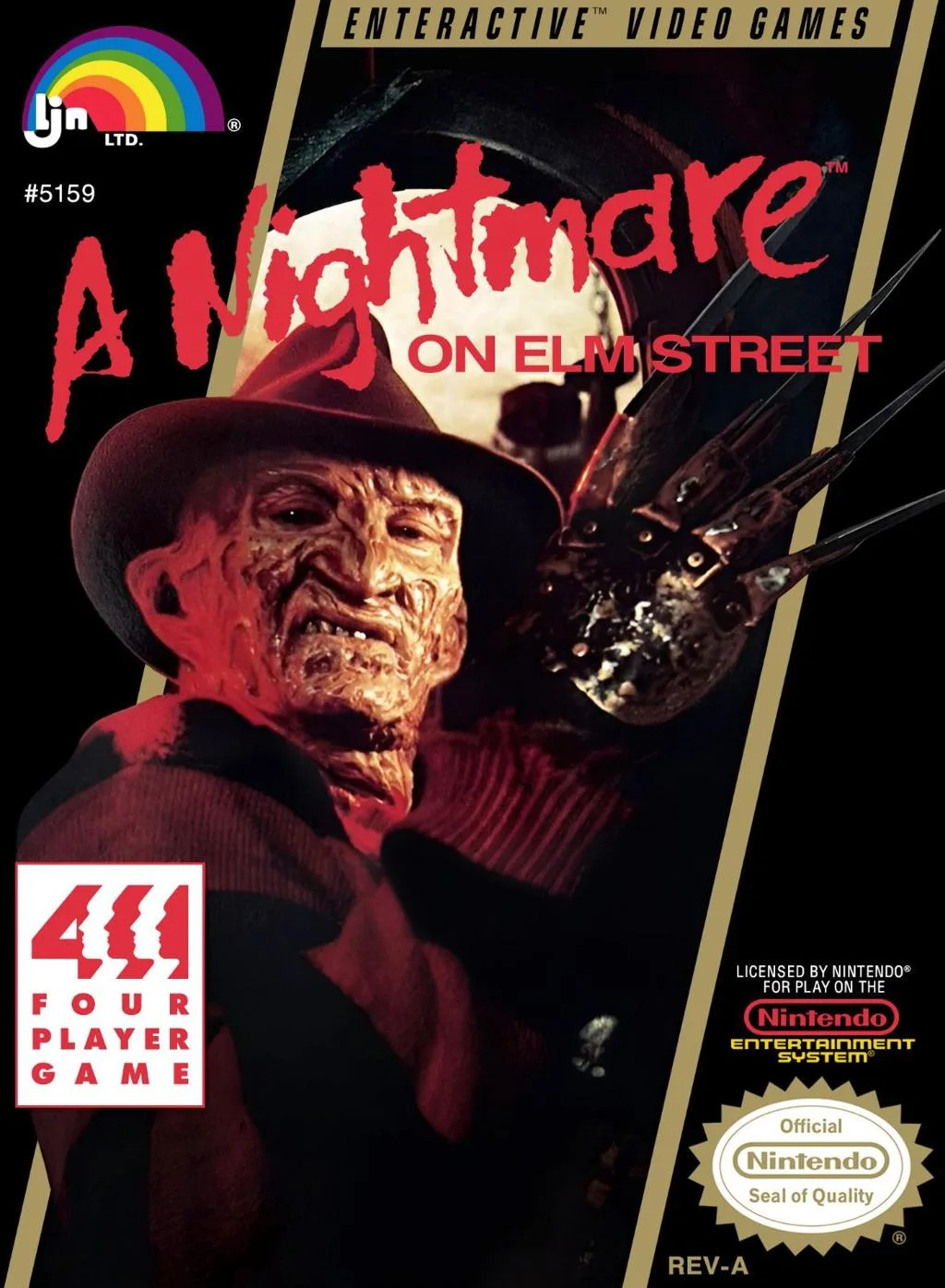
Rare's 1990 NES game: collect the bones, watch the meter
Nintendo Entertainment System · Rare / LJN · Up to four simultaneous players
The Nintendo version sends players through Elm Street's buildings collecting Freddy's scattered bones, ultimately taking them to the high-school furnace. That objective loosely echoes the importance of his remains in Dream Warriors, but the actual journey is a side-scrolling action adventure.
There are platforms, enemies, hidden items, and bosses. Some threats resemble ordinary creatures; others belong more clearly to the supernatural. It is easy to see why players expecting the films' personal, psychological horror found the result strange.
The sleep meter is what makes the game more interesting than that description suggests.
As time passes, wakefulness drains. Coffee helps delay sleep. Once you cross into the dream world, the environment and enemies change, and Freddy becomes a more immediate threat. Waking up is therefore not just a change in scenery. It changes the conditions under which you explore and fight.
A conventional platformer asks how much health you can afford to lose. This one also asks how long you can afford to remain in a particular state.
The nightmare can make you stronger
The game's cleverest decision is refusing to make sleep a straightforward punishment. Dream Warriors give players abilities beyond the waking character's ordinary attacks.
The Acrobat improves movement and offers projectile attacks. The Necromancer brings magic and a different style of movement. The Shadow Warrior adds a martial-arts flavor, with shuriken and flying kicks.
Suddenly staying awake is not obviously the best choice. The waking world delays Freddy, but the dream world can make regular enemies easier to handle. A player who understands the transformations may actively prefer the state the film taught them to dread.
That does not necessarily make the mechanic unsuccessful. It makes it more complicated. The game transforms a cinematic vulnerability into a trade-off, allowing the player to decide which set of dangers feels manageable.
It also changes the tone. Freddy's victims gain the practical confidence of action-game heroes. A nightmare becomes a place where you can test a stronger move set, rather than simply wait to be overwhelmed.
Four friends can change the mood of a nightmare
Simultaneous four-player support is one of the NES game's most distinctive features. With the appropriate multiplayer accessory, a group can explore and fight together rather than take turns watching someone else fall asleep.
That changes more than the number of characters on screen. Solo horror depends partly on isolation; shared play adds coordination, distraction, and comedy. One player's panic becomes another player's opportunity to help—or laugh.
There is something wonderfully uncinematic about four friends collectively attacking a supernatural dream killer. Freddy usually separates his victims and exploits their fears. Here they can arrive as a small, enthusiastic committee.
The feature deserves recognition even if it weakens the mood associated with the first film. A licensed game can pursue a good multiplayer idea without faithfully reproducing every emotional quality of its source.
What matters is whether those systems make sense together. The transformations and cooperative action give the NES game a personality, while repetitive objectives and uneven encounters can still make getting through it a chore.
What the development history adds
A 2026 interview with Rare artist Kevin Bayliss gives firsthand context to the finished cartridge. He recalled a small team developing the adventure, the influence of his interest in martial arts on the ninja-like Dream Warrior, and work to improve the pacing of early encounters.
It is a useful corrective to the assumption that an uneven licensed game must have been made without ideas or care. The result can be flawed while the creative decisions behind it remain worth examining.
Early promotional material also described a substantially different concept in which the player would control Freddy. That perspective fits the wider history of this series: eventually, almost every famous monster is offered a turn on the player's side of the controller.
But surviving advertisements do not establish that a complete, playable lost game is waiting to be recovered. The distinction between a proposed design, promotional material, and a finished prototype matters. The uncertainty is part of the history, not permission to invent the missing cartridge.
David Wise makes a different kind of unease
David Wise's soundtrack gives the NES adventure an identity beyond its unusual mechanics. Short melodies, restless movement, and energetic patterns have to support repeated action while retaining something unsettling.
That is a different task from scoring a film's carefully timed dream sequence. A game theme may continue while the player hesitates, explores, or repeats the same section. It must survive repetition without becoming meaningless noise.
Bayliss also recalled that Wise could not simply reproduce the particular film music he expected. The licensed property and that composition were not interchangeable permissions. The game's musical resemblance therefore had limits.
The result illustrates a recurring adaptation challenge: recognizable characters do not automatically bring every associated sound with them. Sometimes the limitation gives a game room to develop a memorable musical language of its own.
The counting-rhyme association serves a different function. Where a familiar warning suggests that Freddy is approaching, recognition becomes information. Music is not just atmosphere; it helps the player understand what is about to happen.
Freddy leaves the standalone adventure behind
Freddy's 2011 appearance in Mortal Kombat moves his identity into a fighting game's rules. The glove, physical attacks, and supernatural presentation must become readable moves, defenses, and opportunities to retaliate.
That is a character translation rather than an attempt to reproduce Nancy's experience. The pleasure comes from controlling the icon and understanding his capabilities, even though understanding the rules is precisely what the films often deny their victims.
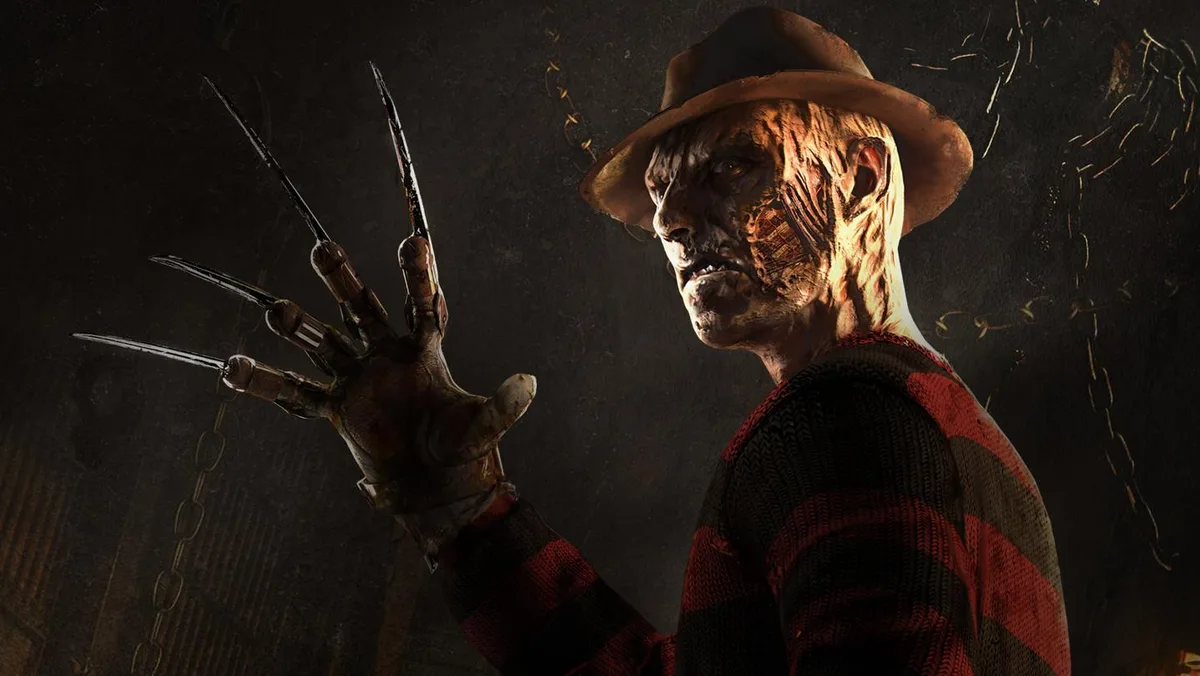
Dead by Daylight took another approach when its Nightmare on Elm Street chapter arrived in 2017. Freddy becomes a player-controlled killer whose dream-based abilities interfere with survivors' understanding of the environment.
The details have changed through updates. The broad idea is more durable: sleep creates a different set of threats, and an apparently useful route or object may no longer be trustworthy. Behaviour's current character description emphasizes Dream Snares, deceptive Dream Pallets, and pressure through generator teleportation.
Those are game systems, not literal recreations of every film rule. But they use Freddy's distinguishing quality effectively: he is dangerous because the place around you can stop behaving as expected.
Which nightmare works best?
Westwood's game turns entering the dream realm into a necessary step toward gaining power. Rare's version makes sleep an active trade-off inside a cooperative platform adventure. Later appearances use Freddy as either a controlled combatant or a human-directed source of uncertainty.
None has to be the single definitive answer. They reveal different qualities in a villain whose identity is unusually flexible.
The NES game is particularly interesting because its reputation can conceal the strength of its central idea. Sleep is not just a timer counting down to failure. It changes the player's tools as well as the danger, allowing experience and preference to reshape the balance.
Its limitations are real: enemies can feel generic, collecting bones can become repetitive, and the dream world's practical advantages can reduce its menace. But those are problems inside an identifiable design, rather than proof that no design exists.
The most promising modern Freddy game would build on uncertainty without making the rules feel arbitrary. A player should have reasons to question a room, a sound, or an apparent escape, while still being able to learn enough to act.
That is a difficult balance. Too much predictability turns nightmares into routine. Too little makes every decision feel pointless.
Freddy's great advantage is that games already let impossible spaces feel convincing. His great challenge is that a player eventually expects to understand how to survive them.
Previously: Part 2 — Friday the 13th. Next: Part 4 — Halloween.
Sources and image credits
- Westwood and Monarch's original computer-game manual: credits, character choice, and nightmare-world abilities.
- Kevin Bayliss's firsthand development interview: Rare's development, music restrictions, and the distinction between earlier promotional concepts and the released game.
- Behaviour's official Nightmare character page: current ability descriptions, which should not be confused with the original 2017 implementation.
Images were supplied with the original draft. Captions identify the depicted material and supplied source labels; rights remain with the respective owners. Film and game spoilers follow throughout this feature.
Keep the horror playing
Listen after dark
If you’d like to keep the atmosphere going, here’s Under The Covers: 12 Nights of Horror—my arrangements of themes from Halloween, Friday the 13th, Jaws, The Exorcist, Silent Hill, and more.