Horror at the Controls: Part 4 — Halloween
- Horror at the Controls
- Horror films
- Horror games
- Atari
- A Nightmare on Elm Street
- Halloween
- The Evil Dead
· Aaron Lehnen · 9 min read
Michael Myers, the Atari 2600, and the danger across the street.
An ordinary house. A quiet sidewalk. Someone standing still at the edge of your vision.
Michael Myers does not need an alien planet or a dream world to make his surroundings frightening. The original Halloween takes familiar suburban spaces and makes them feel unsafe. A window becomes something to check twice. Walking home becomes an exercise in watching the background.
For games, that creates a difficult problem. How do you make a slow, persistent figure threatening when players are accustomed to solving danger by moving faster, attacking repeatedly, or learning a boss pattern?
The answer has changed considerably between a 1983 Atari cartridge and the franchise's modern experiments. Yet one idea keeps returning: Michael matters most when someone nearby needs protecting.
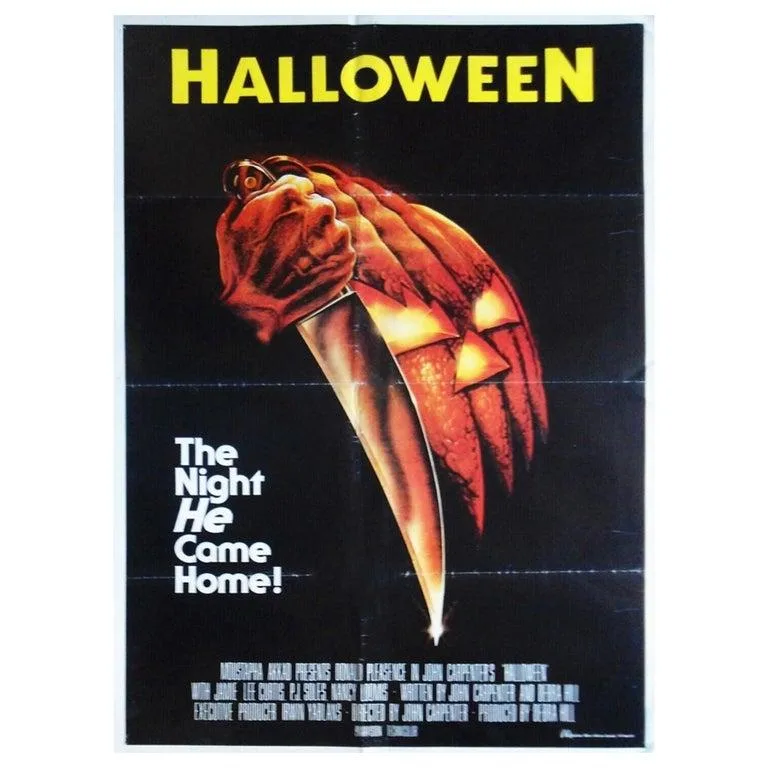
The ordinary world becomes a hunting ground
John Carpenter's 1978 film follows Laurie Strode through a Halloween night in Haddonfield while Michael returns to the neighborhood. Its power comes partly from how little its central threat needs to explain itself.
The Shape is readable enough to recognize and obscure enough to remain unsettling. Carpenter can place him in an otherwise ordinary composition and let the audience do the work. Is he still there? Did Laurie notice? What happened between one shot and the next?
The score is equally economical. Its insistent rhythmic pattern turns anticipation into structure, while the film's use of space allows an apparently uneventful moment to become threatening.
A game cannot rely on exactly the same kind of framing. The player may turn away, sprint through a location, or spend several minutes doing something the film would cut past. Translating Michael therefore means deciding which behavior should carry the fear.
Stalking, rescuing, waiting, and noticing become more useful starting points than simply counting how many times a knife can hit a target.
1983: keep the children alive
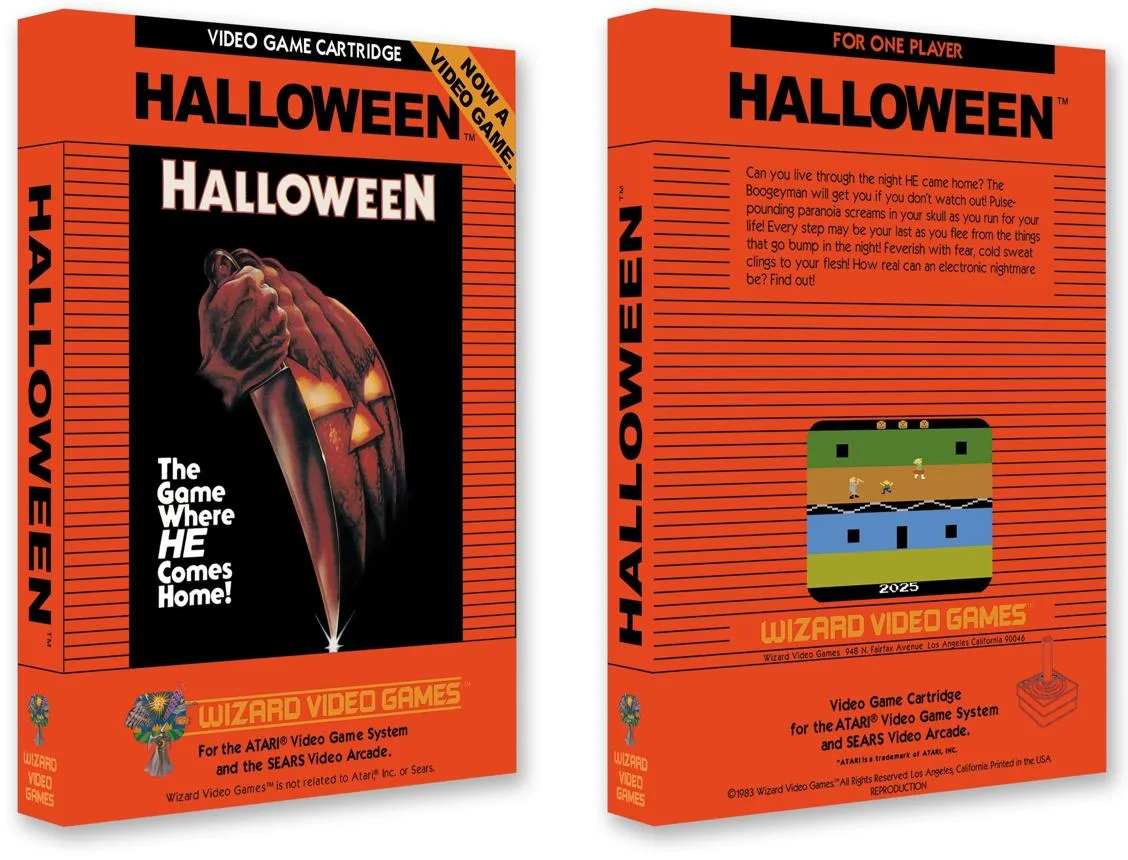
Halloween · Atari 2600 · Wizard Video Games
The early Atari adaptation gives the player a babysitter to control and children to rescue. Michael pursues through a simplified house, and success depends on moving vulnerable people to safety while avoiding his attacks.
That is a surprisingly appropriate foundation. The film's heroine is not a heavily armed soldier. She is trying to understand and survive a threat while looking after people who cannot protect themselves.
The hardware strips the situation down to movement, timing, and recognition. Rooms are simple, characters are small, and elaborate storytelling is unavailable. But the essential conflict remains understandable without a detailed face or a realistic house.
You know who needs help. You know who must be avoided.
A temporary opportunity to fight back does not transform the babysitter into a permanent action hero. The important activity is still getting people away from danger. That gives the game a moral and mechanical identity distinct from Wizard's other notorious horror adaptation, The Texas Chainsaw Massacre.
Both cartridges use famous killers. They ask the player to occupy very different roles.
A few notes can announce the whole problem
Michael's musical identity is valuable on hardware that cannot provide cinematic detail. A recognizable warning can tell the player that the threat has entered the scene before the simplified figure has much opportunity to establish a performance.
This is a small-scale version of a principle that continues through modern horror: sound tells you what kind of attention the world now requires.
The game's death animation also became part of its notoriety. A visibly violent outcome in a sparse Atari world can be startling precisely because there is little else competing for attention. Primitive graphics do not necessarily make a violent premise emotionally neutral.
At the same time, lurid reputation can overwhelm discussion of the design. The interesting historical point is not simply that an Atari game could depict something gruesome. It is that rescue and vulnerability were already available as an alternative to the usual score-chasing combat fantasy.
The cartridge and the controversy
Wizard's horror games arrived at a difficult moment for the American console market. Their adult film licenses and violent premises made them unusual products, and their reputation has since become entangled with rarity, unconventional distribution, and collector stories.
Those stories need care. A surviving handwritten label or reproduction box does not, by itself, establish a universal account of how every copy was produced or sold. Packaging history is worth preserving without turning every striking artifact into an unquestionable production fact.
For this series, the more useful comparison is the one between design and reputation. A controversial license can attract attention that the modest game beneath it cannot possibly satisfy. Decades later, the cartridge may be remembered as forbidden merchandise rather than an experiment in protecting children from a persistent threat.
That reputation tells us something about the period, but it should not replace looking at what the player actually does.
Michael becomes a guest
For many years, the franchise's gaming presence was much less extensive than the film series might suggest. Later guest appearances found new ways to use Michael without building a complete standalone Haddonfield adventure.
In Call of Duty: Ghosts, the 2014 Fog map let players encounter a multiplayer version of the slasher fantasy. The surrounding game still belonged to the language of military competition, but Michael changed what a familiar match could suddenly contain.
Fortnite later used the character in a different way again: a recognizable horror identity inside a much broader social and competitive setting. A figure designed to make the background frightening can become a costume the player deliberately brings into the foreground.
These uses are not lesser simply because they are crossovers. They are answering a different question. A guest appearance asks what players recognize and enjoy about Michael; a dedicated adaptation must also decide what the rest of his world should do.
Dead by Daylight makes watching a mechanic
Michael's arrival in Dead by Daylight in 2016 was especially important because stalking became part of his power. Looking at survivors was not just something the person at the controller might choose to do. It contributed to the killer's progression within a match.
That is a strong example of adapting behavior rather than merely appearance. The films repeatedly show Michael observing before attacking. The game gives that observation consequences, making survivors think about sightlines and exposure.
It also produces an unusual contrast with faster, more visibly aggressive game enemies. A figure standing still can be doing something dangerous. The lack of immediate action becomes part of the threat.
However, the chapter's availability changed. Behaviour announced that the Halloween content would leave new purchases on January 19, 2026, while existing owners retained their characters and cosmetics. Its notice separately said the Haddonfield map would leave the map pool.
That distinction matters: removing content from sale is not necessarily the same as removing everything that existing players already own. It is another reminder that a licensed experience can change shape long after its original release.
RetroRealms: give the monster a platform adventure
RetroRealms: Halloween arrived in 2024 alongside RetroRealms: Ash vs Evil Dead. Developed by WayForward, the games deliberately use the appeal of retro action platformers rather than pretending to recreate a realistic night in the suburbs.
Michael becomes a character with movement, attacks, hazards, and an environment designed to be mastered. The Dark Realm supplies another layer of exploration and danger, while the shared arcade framing makes the pair feel like imaginary horror cabinets from an alternate gaming history.
It is an honest change of objective. The player is not primarily supposed to feel Laurie's uncertainty. They are supposed to enjoy a readable, energetic action game built around the killer's identity.
That makes it useful to compare RetroRealms with the Atari title. One centers on a vulnerable person moving others away from danger. The other places the source of danger in the player's hands. Neither needs to be mistaken for the definitive meaning of Halloween.
The 2026 return to Haddonfield
IllFonic's modern Halloween brings the neighborhood back as a substantial game space, combining an asymmetrical multiplayer premise with a single-player story. Its official site lists the game as available and carries October 2026 updates; the developer's earlier announcement set September 8, 2026 as its release date.
The central opportunity is compelling. Haddonfield can contain people whose lives matter even when they are not the player's chosen character. Moving through the neighborhood becomes a problem of attention: who is isolated, who has noticed the danger, and where is Michael now?
The comparison with 1983 is hard to resist. The old game gave the babysitter children to rescue. Modern hardware can surround players with a neighborhood and ask them to respond to a wider, less predictable situation.
That does not automatically guarantee tension. Complicated behavior, online play, and believable residents all require convincing execution. The question is whether the resulting encounters allow Michael's presence to shape decisions, rather than reduce him to a strong opponent in an otherwise familiar checklist.
This feature treats the release as part of the franchise's continuing history, not as a promise that a recent game's launch condition or online balance will remain unchanged.
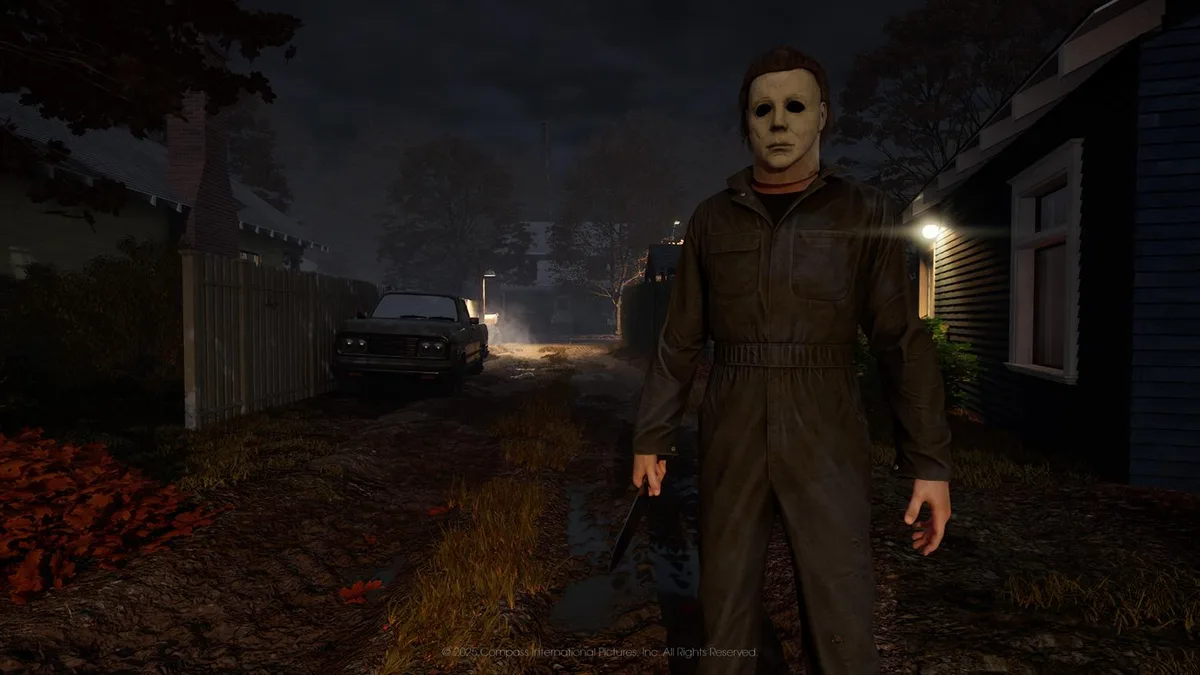
The same street, different fears
The best Halloween game idea may be the one visible inside several of these very different adaptations: make the player responsible for noticing something before it is too late.
The Atari game expresses that through rescue. Dead by Daylight makes observation useful to the killer. A neighborhood-scale game can make civilians, routes, and delayed warnings part of the problem.
What these ideas share is a relationship between time and attention. Michael does not need to sprint constantly if the player has several places to watch and cannot protect everyone at once.
That is also why making him a conventional action enemy can change the mood so dramatically. Once the player understands every attack and has enough room to respond, the Shape becomes manageable. The film's uncertainty has been traded for the satisfaction of mastery.
Sometimes that is exactly what a game wants. RetroRealms does not need to apologize for being an arcade adventure. But an adaptation seeking the first film's suspense needs to preserve the sense that the ordinary world contains a danger the player has not fully accounted for.
A familiar house is only reassuring while you are certain who else is inside it.
Previously: Part 3 — A Nightmare on Elm Street. Next: Part 5 — The Texas Chain Saw Massacre.
Sources and image credits
- Original Atari instruction booklet: the early rescue-and-survival design.
- Behaviour's Halloween availability announcement: January 2026 changes and the distinction between existing ownership and new purchases.
- Nighthawk's RetroRealms announcement: release, developer, and paired platform adventures.
- IllFonic's developer update and the official Halloween game site: release framing and current official updates.
Images were supplied with the original draft. The Atari packaging image comes from a reproduction-box listing and is identified accordingly; it is not presented as proof of an original retail artifact. Rights remain with their respective owners.
Keep the horror playing
Listen after dark
If you’d like to keep the atmosphere going, here’s Under The Covers: 12 Nights of Horror—my arrangements of themes from Halloween, Friday the 13th, Jaws, The Exorcist, Silent Hill, and more.