UFC & PRIDE: The Complete History — UFC 1
- MMA history
- UFC
- Combat sports
· Aaron Lehnen · 7 min read
The Beginning · November 12, 1993 · McNichols Sports Arena, Denver, Colorado
The first UFC promised an answer to a question martial artists had argued about for years: what happens when specialists from different disciplines are allowed to fight one another?
The answer was less tidy than the advertising suggested—and much more important. A boxer could lose without being knocked out. A dangerous striker could discover that his preferred distance no longer existed. A comparatively slender man in a gi could control where a fight happened and how it ended.
Royce Gracie won the tournament. The larger story was the gap between being dangerous in your own sport and being prepared for someone else's.
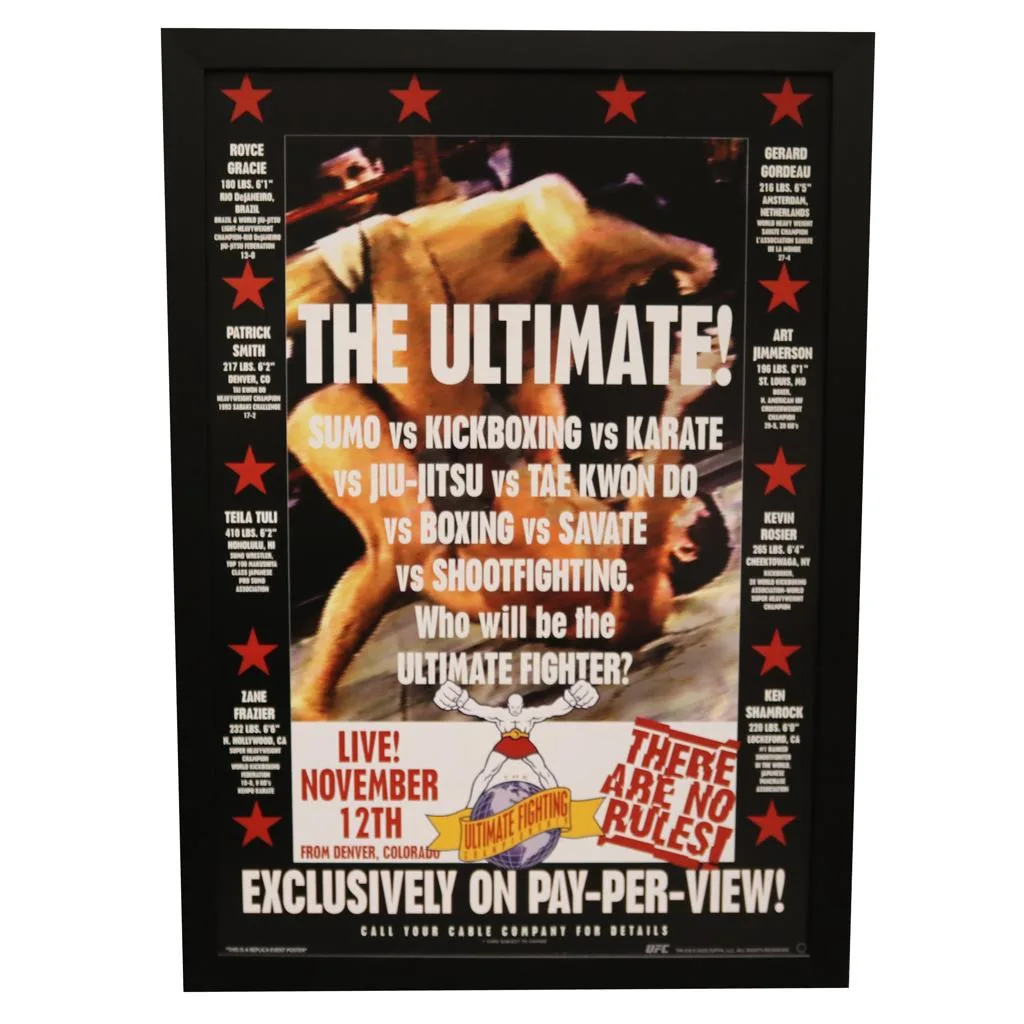
What the event actually was
UFC 1 was an eight-man, openweight elimination tournament, with an additional alternate bout on its record. The champion had to win three times in one evening. There were no modern weight divisions and none of the familiar structure of a present-day five-minute-round UFC card.
It was not the first occasion in history on which different fighting traditions had met. Vale tudo and other cross-style contests already existed. What made this particular show influential was its presentation, television distribution, recognizable style-versus-style premise, and the lessons viewers could see unfolding inside the enclosure.
The “no rules” image also needs qualification. Restrictions existed, including prohibitions on biting and eye gouging, even though the permitted techniques and early officiating arrangements differed sharply from today's regulated sport. The marketing slogan should not be treated as an adequate rules document.
Nor was this a controlled experiment that could settle the worth of every martial art. Eight selected individuals cannot represent the full ability of entire traditions. It was a real tournament with an unusually effective promotional question attached to it.
Eight entrants, different expectations
Royce brought Brazilian jiu-jitsu. Ken Shamrock already understood wrestling and submissions through shootfighting. Gerard Gordeau offered experienced striking, while Teila Tuli's sumo background made his size and forward pressure immediately noticeable.
Art Jimmerson was a professional boxer, visibly arriving with one boxing glove. Patrick Smith and Kevin Rosier brought striking backgrounds, and Zane Frazier completed the field with his own full-contact experience.
These labels help explain the promotion, but they are not complete technical biographies. Fighters can train outside the discipline used to introduce them. The useful distinction is what each man was prepared to do once his opponent stopped cooperating with the assumptions of his preferred contest.
Quarterfinals: the assumptions start breaking
Gerard Gordeau defeated Teila Tuli in 0:26. The size disparity made the opening encounter instantly memorable. Once Tuli was down near the cage, Gordeau's striking ended the fight quickly. Size had not supplied a complete defense against an opponent able to exploit the changed position.
Kevin Rosier defeated Zane Frazier in 4:20. Their much longer striking battle introduced another feature of the format: winning could leave a competitor carrying considerable fatigue into the next round. A tournament bracket did not reset the body between appearances.
Royce Gracie submitted Art Jimmerson in 2:18. The glove became a lasting image, but the decisive issue was positional control. Once Gracie established mount, Jimmerson could not return the contest to a familiar boxing situation. The table uses a broad description of the submission rather than implying that a conventional choke was visibly required to produce the surrender.
Ken Shamrock submitted Patrick Smith with a heel hook in 1:49. This mattered to the evening's wider argument. Gracie was not the only entrant who understood how a submission could end a fight without a knockout. Shamrock represented a meaningful technical challenge to the idea that grappling knowledge belonged to one camp alone.
Semifinals: the anticipated technical test arrives
Gordeau stopped Rosier in less than a minute. Their earlier fights had been very different in duration, reminding viewers that the path through a one-night tournament could affect the eventual matchup as much as the original draw.
Gracie's semifinal against Shamrock was the more revealing clash of grappling experience. Shamrock was familiar with submissions and was not simply another striker discovering the ground for the first time. Gracie nevertheless secured the finish in 0:57.
Historical descriptions differ on the precise choke label. Sherdog records a lapel choke, while other retellings use different terminology. The uncontested essentials are the winner, submission, opponent, and time. Calling it a choke submission preserves those facts without pretending the naming discrepancy does not exist.
That distinction will recur in this archive. A vivid retrospective should not quietly become more certain than the records it relies on.
The final: Royce makes the distance disappear
Gordeau needed room to use his striking. Gracie needed to establish contact and bring the contest into positions where his control and submission attacks mattered more.
The final followed the pattern that made Gracie's evening so influential. He closed the distance, developed control on the ground, and finished with a rear-naked choke at 1:44.
The achievement was not that he had made striking irrelevant. Every opponent still presented danger, and the rules permitted damaging attacks in positions unfamiliar to many viewers. His advantage was being able to change the terms of the encounter and navigate those positions more effectively.
Three wins, all by submission, made the lesson easy to understand. Learning to hit hard did not remove the need to know what happened after a takedown.
Complete recorded results
The rows are grouped by tournament stage, with the alternate bout identified separately; this is not a claim about exact broadcast order.
| Stage | Winner | Loser | Finish | Time |
|---|---|---|---|---|
| Quarterfinal | Gerard Gordeau | Teila Tuli | TKO (head kick) | 0:26 |
| Quarterfinal | Kevin Rosier | Zane Frazier | TKO (corner stoppage) | 4:20 |
| Quarterfinal | Royce Gracie | Art Jimmerson | Submission (mount) | 2:18 |
| Quarterfinal | Ken Shamrock | Patrick Smith | Heel hook | 1:49 |
| Semifinal | Gerard Gordeau | Kevin Rosier | TKO (strikes) | 0:59 |
| Semifinal | Royce Gracie | Ken Shamrock | Choke submission* | 0:57 |
| Alternate | Jason DeLucia | Trent Jenkins | Rear-naked choke | 0:52 |
| Final | Royce Gracie | Gerard Gordeau | Rear-naked choke | 1:44 |
Gracie–Shamrock is shown as a choke submission because detailed historical labels disagree. Jimmerson's surrender from mount is likewise described without forcing a more specific technical claim.
The alternate bout matters to the full event record even though Jason DeLucia did not enter the championship bracket. He submitted Trent Jenkins in 0:52. “Seven tournament fights” and “eight recorded fights” therefore describe different, compatible counts.
Promotion, selection, and what the result proved
The Gracie family's promotional involvement is part of the story. The format provided an unusually effective platform for demonstrating Brazilian jiu-jitsu, and Royce's presentation made the size contrast memorable.
That does not make the victories imaginary. It means the event should be assessed as a promoted competition rather than a neutral scientific survey of every possible fighter and rule set.
Shamrock's presence is particularly important in that discussion. He brought knowledge that directly challenged Gracie's preferred territory. The result still favored Royce, but the encounter itself resists the simplistic claim that he faced only opponents who had never encountered a submission.
The lasting lesson was practical: a fighter needed answers at more than one range. Clinching, takedowns, positional escapes, and submissions could not be dismissed as concerns belonging to someone else's sport.
The beginning of this timeline
This archive follows event dates rather than grouping every UFC show ahead of every PRIDE show. For now the story begins in Denver; PRIDE will enter when the chronology reaches its first event in 1997.
The original tournament is influential enough without turning it into a creation myth for all fighting. Its significance lies in the audience it reached and the visible demonstration of problems many spectators had not previously considered.
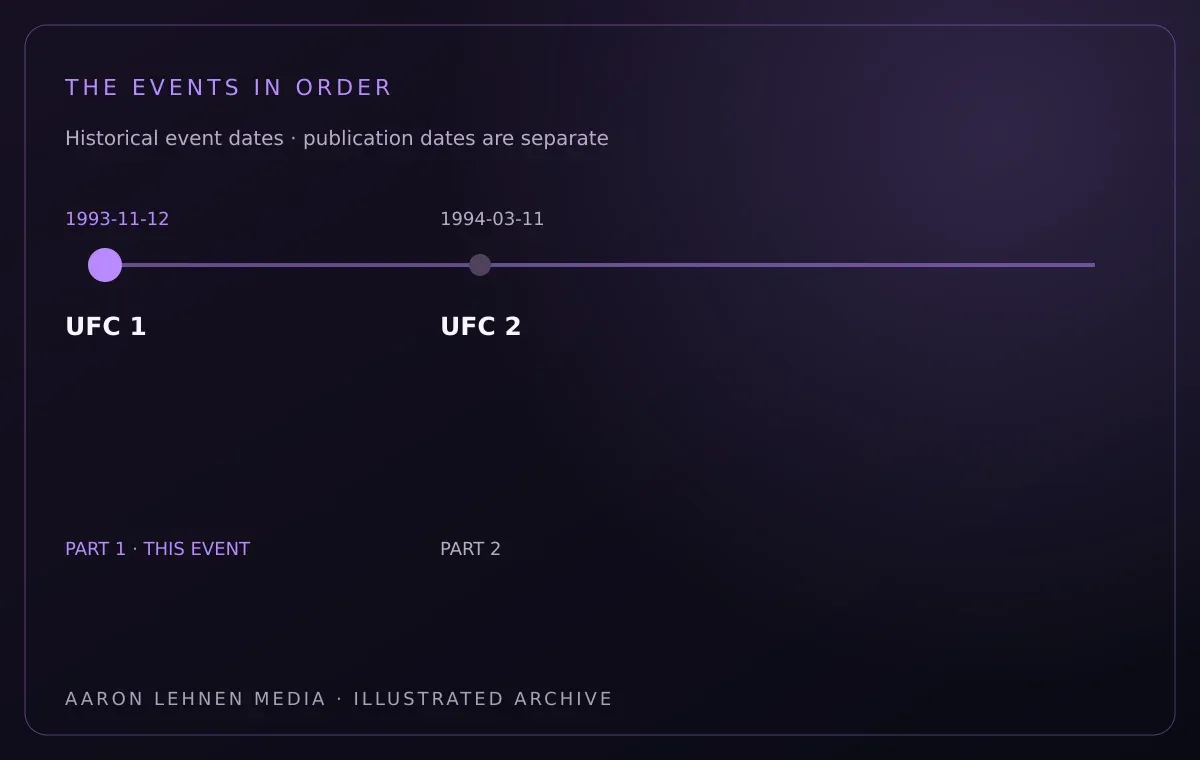
UFC 2 would ask Gracie to solve those problems four times in one night rather than three.
Next event in this archive: UFC 2: No Way Out (Coming November 13, 2026).
Sources and image identification
- UFC's event record: card, broad finish classifications, and recorded times.
- Sherdog's historical card: full event and detailed finish labels, including the lapel-choke classification.
- UFC's retrospective: the event's historical context.
The illustration is a modern replica of event promotional artwork, identified by the supplied CollectibleXchange listing and its visible November 12 advertising. It is not presented as a fight photograph or an authenticated surviving 1993 print. Unverified action photographs from the supplied response are not reproduced.