UFC & PRIDE: The Complete History — UFC 2
- MMA history
- UFC
- Combat sports
· Aaron Lehnen · 7 min read
No Way Out · March 11, 1994 · Mammoth Gardens, Denver, Colorado
Winning three fights had made Royce Gracie the first UFC tournament champion. Defending that position at UFC 2 required four.
The enlarged bracket offered a more demanding version of the original proposition: sixteen starting places, no weight divisions, and one evening in which injury, fatigue, replacements, and technical mismatches could alter everything.
Gracie won again. But the second event also made it harder to ignore a question separate from which martial art worked best: how should a contest end when a fighter could no longer defend himself?
Tournament bracket — round by round
Winners are highlighted. These are the bouts that took place; replacements, withdrawals and byes are explained in the event account below. Alternate bouts and separate title fights remain in the full results.
Opening
Quarterfinal
Semifinal
Final
A sixteen-place bracket is not the whole participant count
The tournament expanded from eight to sixteen starting positions. Fifteen fights were completed, as expected for a single-elimination bracket of that size.
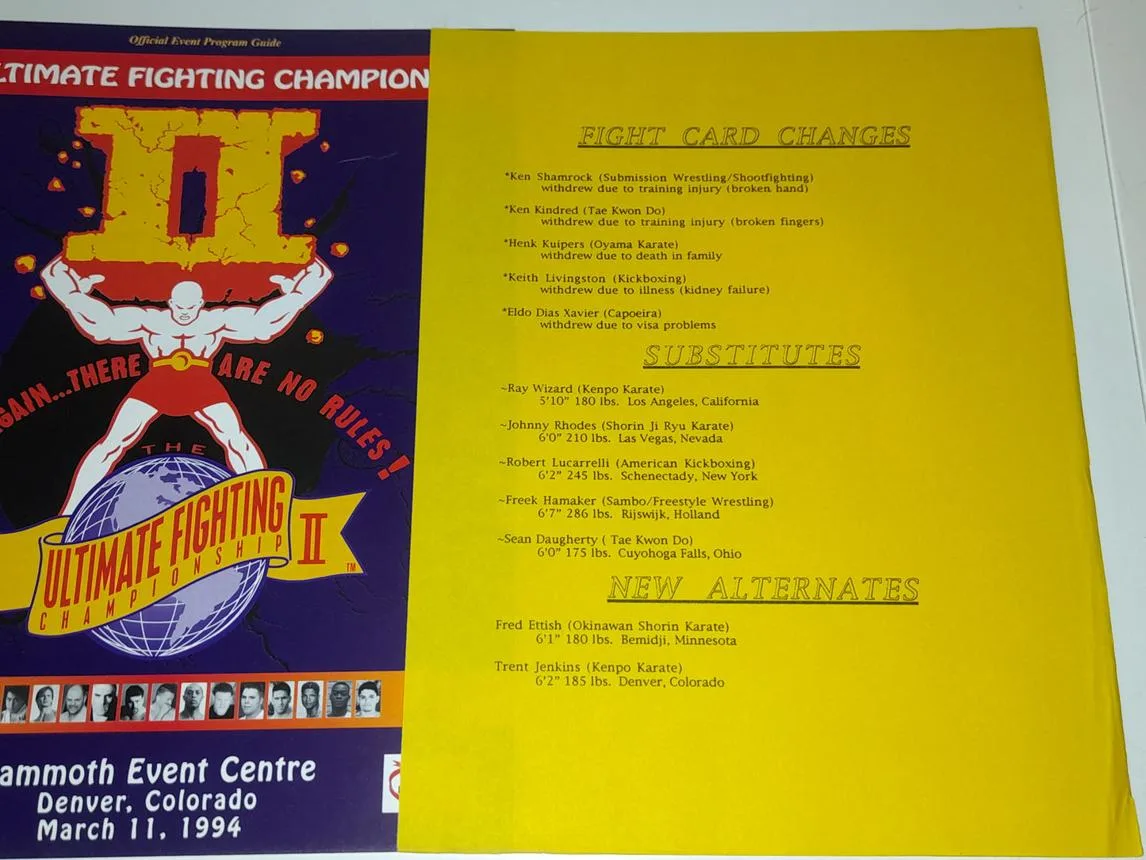
There was a complication. Frank Hamaker won his opening bout but withdrew before the quarterfinals. Fred Ettish entered as a replacement against Johnny Rhodes. That means seventeen different fighters actually competed, even though the tournament is correctly described as a sixteen-man format.
Leaving Ettish out of the participant account would make the later result look as though an unknown name had appeared from nowhere. Treating the replacement as an additional opening-round fight would create a different error.
The venue is given here under its event-era Mammoth Gardens name. Later records also use names associated with the same building, including Fillmore Auditorium. The place should not be mistaken for a different venue simply because a modern database uses a later name.
Opening round: eight routes into the quarterfinals
Scott Morris submitted Sean Daugherty with a guillotine in twenty seconds. Patrick Smith used the same broad type of finish to beat Ray Wizard in 0:58. Smith's participation was an early reminder that an entrant introduced as a striker could still use grappling to win.
Johnny Rhodes required 12:13 to defeat David Levicki, accumulating far more time in the cage than the fighters who finished quickly. Hamaker's win over Thaddeus Luster took 4:52, after which the withdrawal changed Rhodes's next opponent.
Orlando Wiet defeated Robert Lucarelli, Remco Pardoel submitted Alberto Cerra Leon, and Jason DeLucia stopped Scott Baker. Those names represent different backgrounds, but the results alone should not be used to manufacture precise competitive credentials the historical record does not establish.
Gracie's opener against Minoki Ichihara lasted 5:08. Ichihara provided sustained resistance, yet Gracie again brought the contest into a position from which his submission knowledge could decide it.
The evening was larger, but the central technical question had not changed: what happens when a fighter cannot keep the match in the range where he is most comfortable?
Quarterfinals: the event's most troubling image
Patrick Smith's stoppage of Morris in thirty seconds is remembered for its one-sided ground striking. The sequence makes the difference between early UFC officiating arrangements and modern expectations particularly stark.
The historical result is a stoppage victory for Smith. The broader concern is the protection available to a participant once the exchange has become hopelessly unequal. A contest's limited restrictions do not remove the need to recognize that problem.
Accounts of this fight frequently discuss the referee's early authority and the corner's responsibility. Those recollections deserve attribution rather than being treated as permission to repeat every dramatic version of the story as settled fact. The visible mismatch is enough to explain why the fight remains important to the rules discussion.
Rhodes then defeated replacement Ettish in 3:07. Ettish's difficult appearance should be understood in the context of entering a bracket that was already underway, not as a complete judgment on an entire martial tradition.
Pardoel knocked out Wiet with elbows in 1:29. A strong judoka and grappler could use striking from a favorable position; the evening was never as cleanly divided into “people who strike” and “people who submit” as the advertising might suggest.
Gracie submitted DeLucia with an armbar in 1:07. The tournament champion was beginning to make repeated success look methodical, even while the expanded format made reaching the end more demanding.
Semifinals: different amounts of wear
Smith submitted Rhodes with another guillotine in 1:07. Rhodes had already spent considerably longer competing across his first two matches, illustrating the uneven burden a one-night draw could produce.
Gracie's semifinal with Pardoel was an important test because Pardoel understood grappling. This was not simply a submission specialist exploiting an opponent with no ground knowledge at all.
Gracie nevertheless found the finish in 1:31. Detailed historical records identify a lapel choke. His advantage was not merely recognizing that submissions existed, but being able to develop and finish them against increasingly relevant opposition.
That distinction matters to the period's larger story. The practical gap was often in the depth and integration of skills, rather than a complete absence of knowledge on one side.
The final: Smith returns, Gracie repeats
Smith had rebuilt his campaign after losing to Ken Shamrock at UFC 1. Three victories put him opposite the defending tournament champion, with both strikes and submissions already contributing to his success.
The final ended quickly once Gracie established control and attacked on the ground. Smith surrendered to punches at 1:17.
Historical finish labels sometimes confuse readers here. A fighter can submit because of strikes, while a database classifies that outcome as TKO rather than a technical submission hold. The table preserves that distinction instead of inventing a choke that was not the recorded finish.
Four wins in one night gave Gracie a second tournament championship. The expanded format had increased the burden without producing an opponent who could stop his progression through the bracket.
Complete recorded results
Rows are grouped by bracket stage. The replacement changes the participant count, not the total number of completed fights.
| Stage | Winner over loser | Finish | Time |
|---|---|---|---|
| Opening | Morris over Daugherty | Guillotine | 0:20 |
| Opening | Smith over Wizard | Guillotine | 0:58 |
| Opening | Rhodes over Levicki | TKO (submission to punches) | 12:13 |
| Opening | Hamaker over Luster | TKO (corner stoppage) | 4:52 |
| Opening | Wiet over Lucarelli | TKO (corner stoppage) | 2:50 |
| Opening | Pardoel over Cerra Leon | Submission (armlock) | 9:51 |
| Opening | DeLucia over Baker | TKO (submission to punches) | 6:41 |
| Opening | Gracie over Ichihara | Lapel choke | 5:08 |
| Quarterfinal | Smith over Morris | KO (elbows) | 0:30 |
| Quarterfinal | Rhodes over Ettish | Choke | 3:07 |
| Quarterfinal | Pardoel over Wiet | KO (elbows) | 1:29 |
| Quarterfinal | Gracie over DeLucia | Armbar | 1:07 |
| Semifinal | Smith over Rhodes | Guillotine | 1:07 |
| Semifinal | Gracie over Pardoel | Lapel choke | 1:31 |
| Final | Gracie over Smith | TKO / submission to punches | 1:17 |
Detailed records vary in whether a surrender to strikes is placed under submission or TKO. The wording above describes the decisive action as well as the classification. Spellings also vary: the table uses Orlando Wiet and Sean Daugherty, while some UFC records render those names differently.
What changed after Denver's second tournament?
UFC 2 reinforced the competitive value of grappling while exposing the limits of the spectacle surrounding it. A decisive finish could educate the audience about technique; a prolonged or one-sided beating could also raise questions the promotion's slogan did not answer.
The expanded field made endurance and bracket luck more visible. Winning an early fight did not guarantee that a competitor would be physically able to take the next one. An alternate's appearance was not a footnote if it changed whom another fighter had to face.
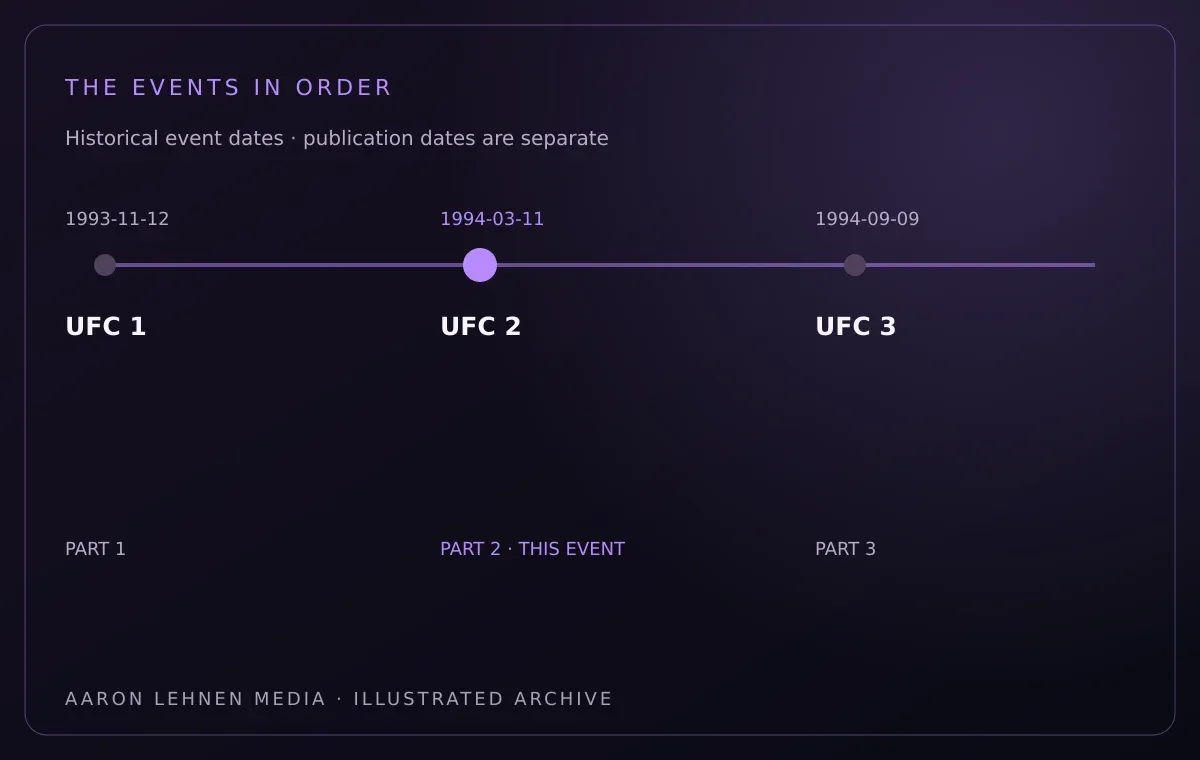
Those structural problems would become central at UFC 3. Gracie remained unbeaten in his completed UFC fights, but remaining unbeaten and remaining capable of continuing were about to become very different things.
Previously: UFC 1: The Beginning. Next: UFC 3: The American Dream (Coming November 20, 2026).
Sources and image identification
- UFC's event record: participants, results, and times.
- Sherdog's full card: the replacement's appearance and detailed result classifications.
- The supplied program listing: photographed event-program material, used as an illustration of promotion rather than proof that the announced bracket remained unchanged.
- MMAWeekly's event archive: the supplied UFC II artwork context.
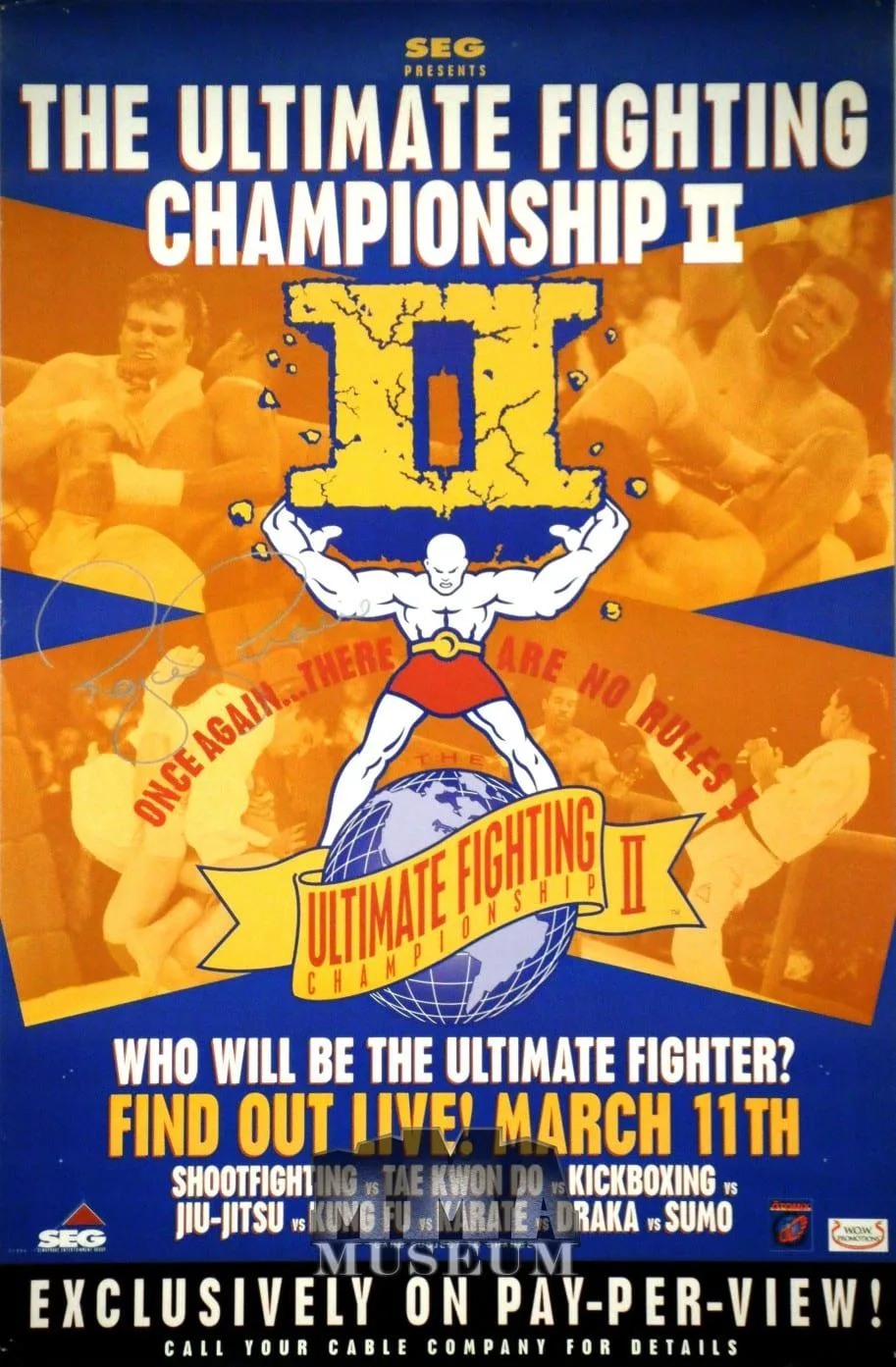
Both illustrations are event promotional or program material. Neither is presented as documentary photography of a completed fight. Original rights remain with their respective owners.