UFC & PRIDE: The Complete History — UFC 3
- MMA history
- UFC
- Combat sports
· Aaron Lehnen · 7 min read
The American Dream · September 9, 1994 · Grady Cole Center, Charlotte, North Carolina
Royce Gracie won his fight. Ken Shamrock won twice. Neither man finished the evening as champion.
Instead, alternate Steve Jennum took the tournament after one completed bout, a final lasting 87 seconds. UFC 3 is the point at which the bracket itself becomes as important as the fighters inside it.
The event did not demonstrate that Gracie's earlier victories had stopped mattering. It demonstrated that winning an individual fight and surviving an entire one-night tournament were different accomplishments.
Tournament bracket — round by round
Winners are highlighted. These are the bouts that took place; replacements, withdrawals and byes are explained in the event account below. Alternate bouts and separate title fights remain in the full results.
Quarterfinal
Semifinal
Final
The champion arrives unbeaten
Gracie entered Charlotte with seven completed UFC victories and two tournament titles. Shamrock returned with the obvious possibility of a rematch after losing their UFC 1 semifinal.
The starting field also included returning and debuting specialists: Keith Hackney, Emmanuel Yarbrough, Christophe Leininger, Harold Howard, Roland Payne, and Kimo Leopoldo.
That promised another collection of cross-style questions. The tournament instead developed into a test of physical availability: who could continue after winning, and who would replace the people who could not?
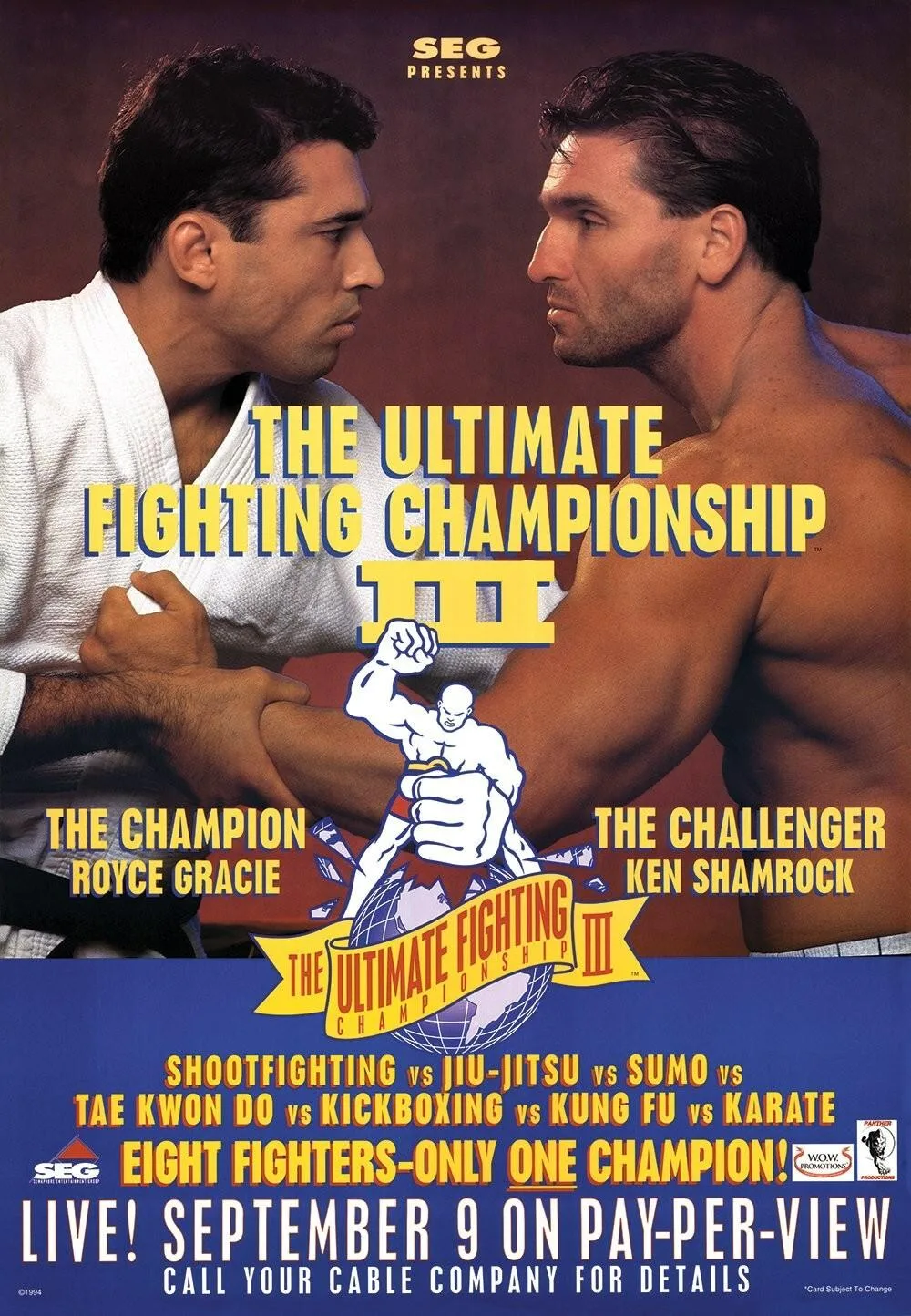
The promotional artwork illustrates the difference between expectation and outcome. It presents Gracie and Shamrock as the central attraction. It does not document a Gracie–Shamrock fight at UFC 3, because that match never happened.
Hackney and Yarbrough: size does not settle the exchange
The enormous difference in size made Hackney versus Yarbrough immediately striking. Yarbrough's sumo background and exceptional frame were central to the presentation; Hackney's task was to remain effective without being overwhelmed by that pressure.
Hackney won by strikes in 1:59. The encounter included the famous failure of the Octagon door during the larger man's advance, an uncomfortable reminder that the enclosure and its practical demands were still part of a developing production.
But Hackney's victory did not leave him ready to continue. An injured hand removed him from the bracket, creating the first major substitution of the night.
A knockout or submission could answer who had won the exchange. It could not guarantee the winner's ability to use the same tools again a few minutes later.
Shamrock, Howard, and Gracie advance
Shamrock defeated judoka Christophe Leininger at 4:49. The contest gave him another opportunity to show that his submission-wrestling experience could function against an opponent familiar with taking people down.
Howard stopped Payne in 0:46, the shortest of the completed quarterfinals. Its significance grew later, because Howard would not need to contest a semifinal before reaching the final.
Gracie's meeting with Kimo was the turning point. Kimo's strength and resistance made the champion work considerably harder than the bare result might imply. Gracie secured an armbar at 4:40, extending his winning record.
That result should not be rewritten into a Kimo victory simply because Gracie could not continue afterward. The distinction is the whole story: Kimo lost the completed bout, while the effort Gracie spent winning it contributed to a very different tournament outcome.
It is possible to recognize the importance of resistance without changing who actually won.
The semifinal that happened
Felix Mitchell replaced Hackney against Shamrock. An alternate entered fresher than the man who had already fought, but freshness did not supply the same grappling control.
Shamrock won by rear-naked choke in 4:34. Two victories had put him in line for the championship final, while the other side of the bracket was about to change without a completed fight.
The substitution also illustrates why a fighter's introduction in a results table needs context. Mitchell was not another original quarterfinal winner whose earlier bout has been omitted. He entered because the winner of that place in the bracket could not continue.
The semifinal that did not happen
Gracie's corner withdrew him before a bout with Howard could begin. Historical accounts describe exhaustion and difficulty recovering after the Kimo contest. The essential competitive fact is simpler: Howard advanced without a contested semifinal.
This article does not add a zero-second Howard–Gracie fight to the six completed results. Nor does it convert the withdrawal into evidence that Gracie had been defeated inside the cage by Howard.
Older records and tournament diagrams can represent advancement differently. A bracket needs to show who moved forward; a fight record needs to identify what actually took place. Combining those two purposes carelessly is how a tournament history acquires a fight that never began.
Shamrock also withdrew before the final. Later discussion of his disappointment at losing a Gracie rematch should not be presented as a definitive finding about his motives. The bracket changed again, and another alternate became necessary.
Jennum's 87 seconds
Jennum entered against Howard without having fought earlier in the tournament. He secured a takedown, established control, and forced the stoppage through punches at 1:27.
The result made him the official tournament champion. It also made the unequal workload impossible to ignore. The champion had one completed fight; some of the men removed from the bracket had already endured far more competition.
Those observations are compatible. Jennum won the final he was placed in. The format that placed him there created a substantial advantage in accumulated fatigue and exposure.
Calling him an illegitimate winner would blur the distinction between criticizing tournament design and denying a result recorded under that design. The useful question is what the promotion needed to change if it wanted the title to represent a more comparable route through the evening.
Six completed fights
The table lists contested bouts. Withdrawals and byes are explained separately rather than assigned invented fight times.
| Stage | Winner | Loser | Method | Time |
|---|---|---|---|---|
| Quarterfinal | Keith Hackney | Emmanuel Yarbrough | TKO (punches) | 1:59 |
| Quarterfinal | Ken Shamrock | Christophe Leininger | TKO / submission to punches | 4:49 |
| Quarterfinal | Harold Howard | Roland Payne | KO (punch) | 0:46 |
| Quarterfinal | Royce Gracie | Kimo Leopoldo | Submission (armbar) | 4:40 |
| Semifinal | Ken Shamrock | Felix Mitchell | Rear-naked choke | 4:34 |
| Final | Steve Jennum | Harold Howard | TKO / submission to punches | 1:27 |
Bracket changes: Hackney withdrew and Mitchell replaced him; Gracie withdrew before the Howard semifinal; Shamrock withdrew before the final and Jennum replaced him. Howard's advancement is not an additional completed bout.
What this tournament exposed
A one-night tournament creates two overlapping competitions. One is technical: can you defeat the person opposite you? The other is logistical and physical: can you remain available while the bracket around you changes?
UFC 3 made the second competition unusually visible. A hand injury changed one semifinal. The defending champion's inability to recover removed the expected final. A second withdrawal created a winner who had barely been part of the evening until its last decisive exchange.
None of that makes the fighting irrelevant. It explains why the sport could not develop through technique alone. Rules for replacements, the authority of officials, recovery, and the demands of a televised event all shaped what a championship meant.
The photographs and stories surrounding the show need the same discipline. An event poster advertising two stars is not evidence of their matchup. A memorable account of a withdrawal is not permission to infer cowardice, deception, or a secret agreement.
The actual events are unusual enough without inventing additional drama.
From the American Dream to another Gracie return
Gracie's completed UFC record had reached eight wins without a loss, but his run of tournament championships had ended. Shamrock had demonstrated his ability again and still failed to receive the expected rematch. Jennum left with the title and a conspicuously short route to it.
The next event would force the UFC to revisit those competing stories. Gracie returned. Jennum had to fight again. Dan Severn introduced a different scale of wrestling challenge.
UFC 3's legacy is that a result sheet can be accurate and still need a bracket beside it. Understanding who fought is only the beginning of understanding who advanced.
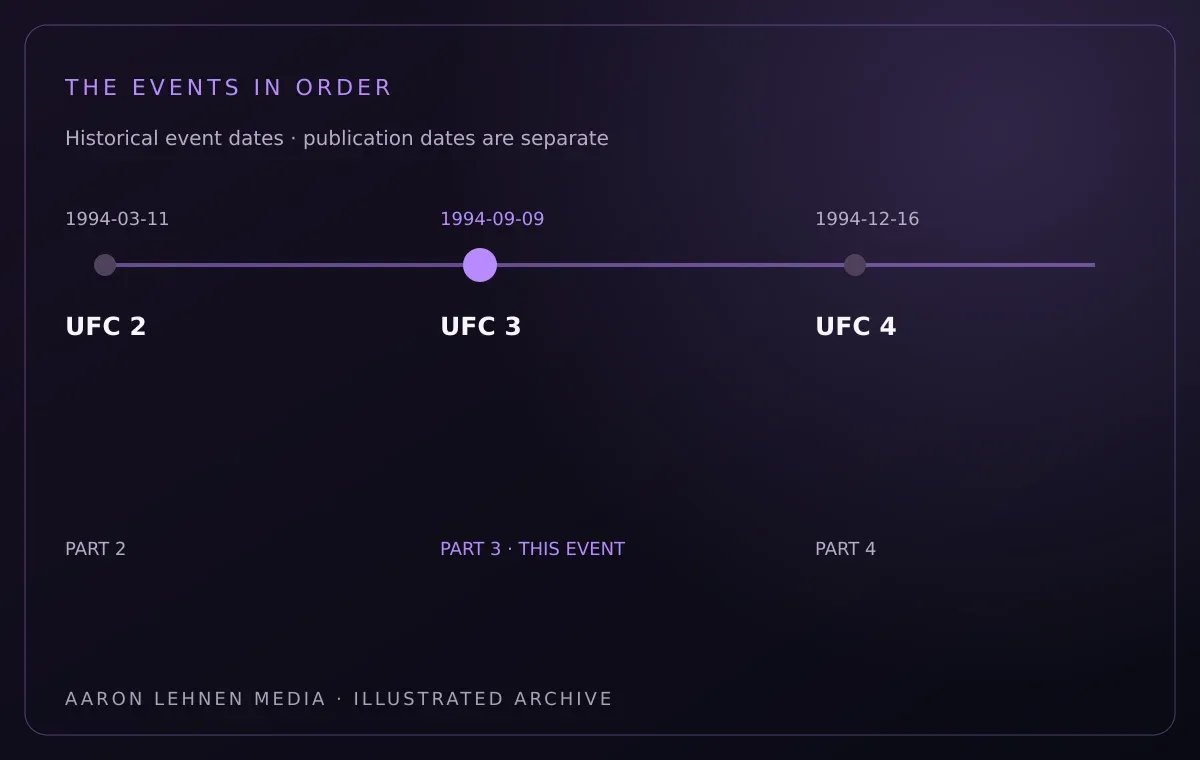
Previously: UFC 2: No Way Out. Next: UFC 4: Revenge of the Warriors (Coming November 27, 2026).
Sources and image identification
- UFC's event record: completed bout results and times. Some older page fields are incomplete; this article cross-checks the named opponents.
- Sherdog's event record: the six completed contests and historical venue.
- UFC's historical moments retrospective: Jennum's alternate entry and the period's unusual tournament history.
- The supplied poster listing: UFC III promotional artwork, not authenticated action photography.
The illustration advertises Gracie and Shamrock as promotional attractions. They did not fight each other at this event. No uncertain fight photographs are reproduced.