UFC & PRIDE: The Complete History — UFC 4
- MMA history
- UFC
- Combat sports
· Aaron Lehnen · 8 min read
Revenge of the Warriors · December 16, 1994 · Expo Square Pavilion, Tulsa, Oklahoma
For most of the final, Dan Severn appeared to have the position a wrestler would want. Royce Gracie was underneath him, absorbing pressure and looking for a way to change the contest.
The finish demonstrated why position alone could be misleading. After 15:49, Gracie's triangle choke ended the evening and returned the tournament championship to the man who had won the first two events.
UFC 4 is remembered for that reversal, but its full story also includes alternates, a returning champion, disturbing use of the event's permissive rules, and a growing conflict between open-ended fighting and the television schedule.
Tournament bracket — round by round
Winners are highlighted. These are the bouts that took place; replacements, withdrawals and byes are explained in the event account below. Alternate bouts and separate title fights remain in the full results.
Quarterfinal
Semifinal
Final
Different kinds of unfinished business
Gracie returned after winning his UFC 3 quarterfinal but being unable to continue. Steve Jennum returned as the defending tournament champion, this time facing the prospect of more than one fight. Keith Hackney returned after an injury had removed him from the previous bracket.
Severn brought extensive wrestling experience and a physical approach that promised a different test. The question was not simply whether he could put an opponent down. It was what he could do once there against a fighter whose attacks did not require being on top.
Other entrants and additional bouts widened the cast, but the event's decisive theme would be the difference between controlling where a fight happened and controlling every danger within that position.
Additional bouts and an alternate who would matter
Joe Charles submitted Kevin Rosier with an armbar in fourteen seconds. Marcus Bossett defeated Eldo Dias Xavier by punches at 4:55. Guy Mezger later stopped Jason Fairn in 2:13.
These bouts belong in a complete event record, even though they are outside the seven-fight championship bracket as it originally started. Grouping them below as additional bouts avoids presenting all fourteen participants as if they were original tournament entrants.
Bossett's earlier win became relevant when he replaced Jennum in the semifinal against Severn. A supporting contest could therefore shape the championship story directly, rather than remaining a disconnected preliminary result.
The bracket was still a moving structure, not just a graphic showing eight names in permanent places.
Quarterfinals: Gracie and Severn set different tempos
Gracie submitted veteran martial artist Ron van Clief with a rear-naked choke. The UFC event page lists 3:49; Sherdog lists 3:59. The table uses the UFC's clock and marks the disagreement rather than quietly choosing one number and claiming unanimity.
Hackney's encounter with Joe Son became notorious for repeated groin strikes, permitted under the event's unusually limited restrictions. The recorded finish is a choke submission at 2:44, not simply a knockout from the most infamous part of the sequence.
That distinction matters. A memorable action can dominate later retellings without being the official description of how the contest ended. It also illustrates why these early rules should not be confused with present-day expectations about fouls and protection.
Jennum submitted boxer Melton Bowen with an armbar in 4:47. That win deserves recognition in its own right: the previous event's champion had now completed another contest rather than merely inheriting a place in a final. He nevertheless could not continue through the next round.
Severn submitted Anthony Macias in 1:45 after imposing his wrestling. The visual contrast was immediately useful to the promotion. Here was a formidable grappler who did not arrive in a Gracie gi and who could put his own form of control at the center of the evening.
Semifinals: an armbar and another replacement
Gracie's semifinal against Hackney lasted 5:32 and ended with an armbar. Hackney could strike dangerously, but maintaining a contest at striking range was a different problem from possessing dangerous strikes.
On the other side, Bossett entered for Jennum and lost to Severn by choke in 0:52. Severn reached the final after spending considerably less time competing than Gracie had across his opening two bouts.
That difference did not decide the result by itself, but it belonged to the context. Tournament performance combines what happens in each fight with what those fights leave behind.
For Gracie, the championship would require an answer to a fresh, forceful wrestling problem. For Severn, it would require making top position safe against an opponent who could attack from below.
The final: what top control did not guarantee
Severn put Gracie on his back and maintained substantial pressure. To spectators accustomed to judging a fight primarily by who appeared physically dominant, the picture could look like an increasingly settled argument.
It was not settled. Gracie was defending, controlling distance with his legs and arms, and looking for an arrangement that could threaten the neck and shoulder line without first reversing to the top.
The eventual triangle made that possibility decisive. Severn submitted at 15:49. Gracie's third UFC tournament championship came from a finish that many viewers did not yet have the knowledge to anticipate.
The lesson should not be exaggerated into “wrestling does not work.” Severn had reached the final and controlled important portions of it. The narrower, more useful lesson is that an advantageous wrestling position can contain submission dangers a wrestler must learn to recognize.
Nor does the finish prove that Gracie had been in complete comfort throughout. A successful defensive strategy and a physically demanding fight can coexist. The submission explains the result; it does not erase the effort required to create it.
Complete recorded results
These rows identify the championship stages and additional bouts; their grouping is not an asserted running order for every broadcast segment.
| Stage | Winner | Loser | Finish | Time |
|---|---|---|---|---|
| Additional bout | Joe Charles | Kevin Rosier | Armbar | 0:14 |
| Additional bout | Marcus Bossett | Eldo Dias Xavier | KO (punches) | 4:55 |
| Quarterfinal | Royce Gracie | Ron van Clief | Rear-naked choke | 3:49* |
| Quarterfinal | Keith Hackney | Joe Son | Choke | 2:44 |
| Quarterfinal | Steve Jennum | Melton Bowen | Armbar | 4:47 |
| Quarterfinal | Dan Severn | Anthony Macias | Rear-naked choke | 1:45 |
| Semifinal | Royce Gracie | Keith Hackney | Armbar | 5:32 |
| Semifinal | Dan Severn | Marcus Bossett | Rear-naked choke | 0:52 |
| Additional bout | Guy Mezger | Jason Fairn | TKO (corner stoppage) | 2:13 |
| Final | Royce Gracie | Dan Severn | Triangle choke | 15:49 |
The UFC page records Gracie–van Clief at 3:49; Sherdog gives 3:59. The winner and submission are not disputed by those records. The table retains the UFC time and flags the difference.
The television problem
The final's duration became part of the event's wider legacy because some pay-per-view coverage ended before viewers saw the conclusion. A contest that continued until a finish did not necessarily fit the length of the slot carrying it.
That was more than an inconvenience for an audience. The promotion was trying to sell a decisive answer at the end of an elimination tournament. Losing the decisive moment exposed a weakness in the relationship between the sporting format and the product being broadcast.
It is worth describing the problem without inventing a precise number of affected households. The historical point is the conflict: an event cannot reliably promise an open-ended final and also assume that the television infrastructure will wait indefinitely.
The next phase of the UFC would make time limits and separate headline attractions increasingly important. Those changes did not arise only from philosophical arguments about what constituted a proper fight. Broadcasting and business had practical demands of their own.
The controversies need boundaries
Hackney–Son warrants discussion because the footage and event record establish what occurred. Speculation that another participant deliberately arranged an easy defeat is a different category and should not be presented as proven without reliable evidence.
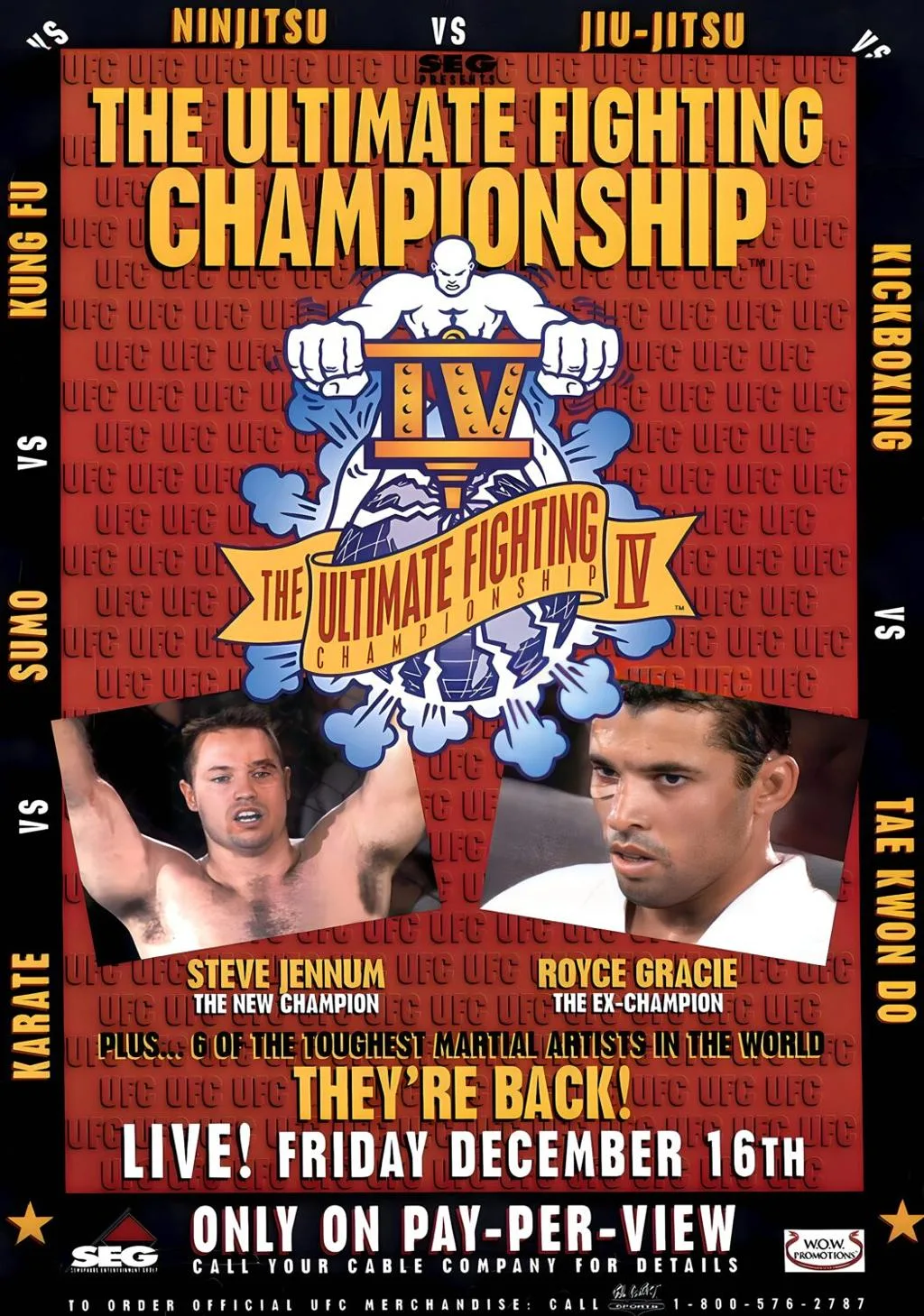
The same discipline applies to promotional imagery. The supplied UFC IV artwork features Jennum and Gracie, reflecting the way the event was sold. They did not meet in the championship final; Gracie fought Severn.
Using that poster as evidence of a Jennum–Gracie matchup would reproduce exactly the kind of historical confusion this archive is intended to avoid.
The event provides enough real tension: a dangerous new wrestler, a champion returning from an interrupted campaign, an alternate changing the bracket, and a submission that overturned a misleading picture of dominance.
A third title, and a different next question
Gracie again left with the tournament championship, but Severn had established himself as more than a stylistic demonstration. His wrestling supplied a path through the field and a serious problem in the final.
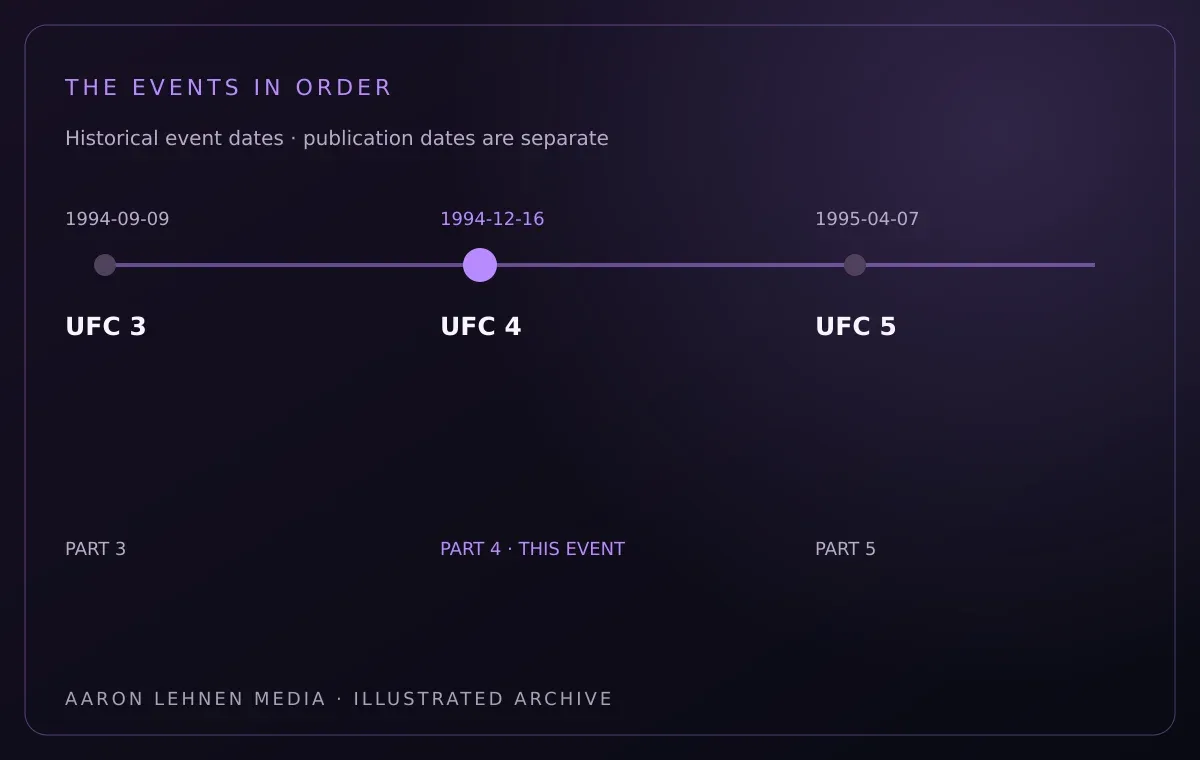
The next show would divide attention between another tournament and a long-awaited Gracie–Shamrock rematch. UFC 4's ending had made a finish look essential to the product. UFC 5 would reveal what happened when the clock arrived first.
Previously: UFC 3: The American Dream. Next: UFC 5: The Return of the Beast (Coming December 4, 2026).
Sources and image identification
- UFC's event record: the complete card and the 3:49 van Clief clock used here.
- Sherdog's full card: detailed finishes and the alternative 3:59 clock.
- Contemporary-history discussion of the broadcast cutoff: why the final exceeded the broadcast window.
- The supplied reproduction listing: the pictured UFC IV artwork. The visible artwork features Jennum and Gracie despite the listing's broader title.
The image is a reproduction of event promotion, not a photograph of the final. Its advertised personalities must not be mistaken for a bout that occurred. Original rights remain with the relevant owners.