Horror at the Controls: Part 7 — Alien
- Horror at the Controls
- Horror films
- Horror games
- SNES
- Atari
- The Evil Dead
- Alien
- The Thing
· Aaron Lehnen · 11 min read
From the Nostromo to Isolation: when the scariest thing in the room became the rules.
A motion tracker is useful until it tells you something you would rather not know.
That is the problem at the heart of Alien. Information can help you survive without making you feel safe. A shape is moving nearby; the sound is getting closer; knowing that much does not tell you which decision will keep you alive.
Few horror franchises have offered game developers such a wide range of interpretations. The Xenomorph has been an arcade enemy, a tactical problem, a player-controlled predator, and a threat that makes hiding under a desk feel like an ambitious plan.
The history is long enough to become a catalog. The more interesting story is how often its games move between the vulnerability of Alien and the armed resistance of Aliens—and how difficult it is to keep either one frightening after the player learns the rules.
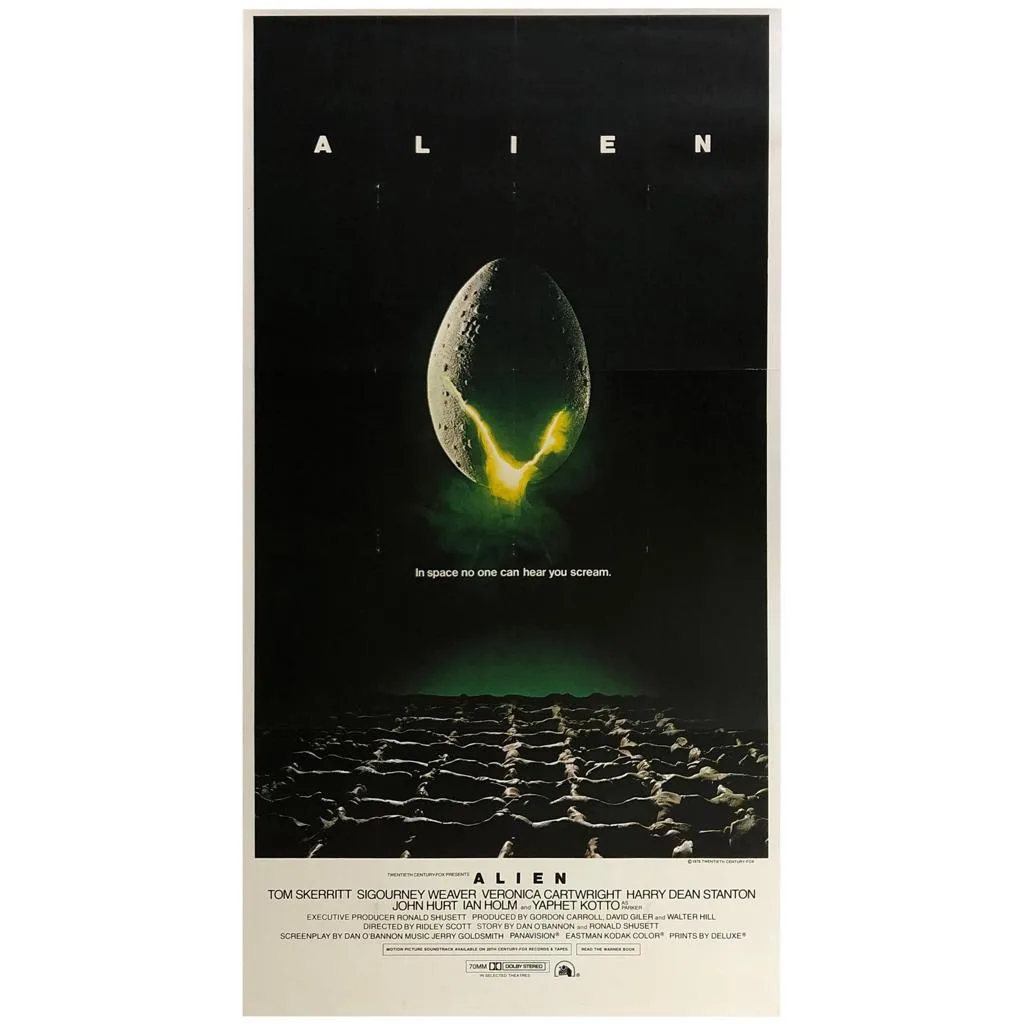
A haunted workplace in space
Ridley Scott's 1979 film traps the crew of the Nostromo with a creature whose abilities they barely understand. Its industrial corridors and practical equipment make the ship feel used, functional, and deeply inconvenient to escape.
The setting is important because the crew are not introduced as specialists in destroying monsters. Their workplace becomes hostile, and the tools around them were not designed to resolve the problem they now face.
H. R. Giger's creature design makes the threat both biological and difficult to classify. Jerry Goldsmith's score and the film's environmental sound help turn quiet areas into places where something may be waiting.
James Cameron's Aliens changes the balance in 1986. The survivors have military support and considerably more firepower, but equipment and training do not prevent the situation from deteriorating. The franchise now offers two compatible but distinct fantasies: survive a single overwhelming predator, or try to hold a group together under escalating attack.
Game designers could choose either. Many chose both, with mixed results.
Early computers find two different kinds of maze
The 1982 Atari Alien uses a maze-game structure, translating the license into activities that fit the console and the arcade conventions of the period. It is a reminder that a film adaptation could once be recognizable primarily through its theme rather than through an attempt to recreate its scenes.
That does not automatically make the result worthless. A maze can create pursuit, blocked routes, and the pressure of deciding where to move next. But the relationship to the film becomes abstract: the player is managing a familiar game format with an unfamiliar monster's name attached.
The 1984 computer Alien takes a more situation-oriented approach. Managing crew members and moving around a dangerous ship offers a way to make the wider cast matter. The player has responsibilities beyond the survival of one highly capable protagonist.
That is an especially strong match for the original film. A ship is a network of locations, people, and imperfect information. Moving someone toward an objective can also expose them to a threat the player cannot fully locate.
The important advance is conceptual rather than graphical. Alien does not need to become a conventional shooter. It can become a problem of command, timing, and uncertainty about what is happening somewhere else.
Aliens gives developers permission to open fire
The 1986 Aliens computer adaptations were not simply one identical game distributed everywhere. Different interpretations used the license to organize action, encounters, and squad responsibilities in different ways.
That distinction matters throughout this history. A film title printed on two boxes does not guarantee equivalent rules, objectives, or development teams. Platform-specific games often deserve separate treatment.
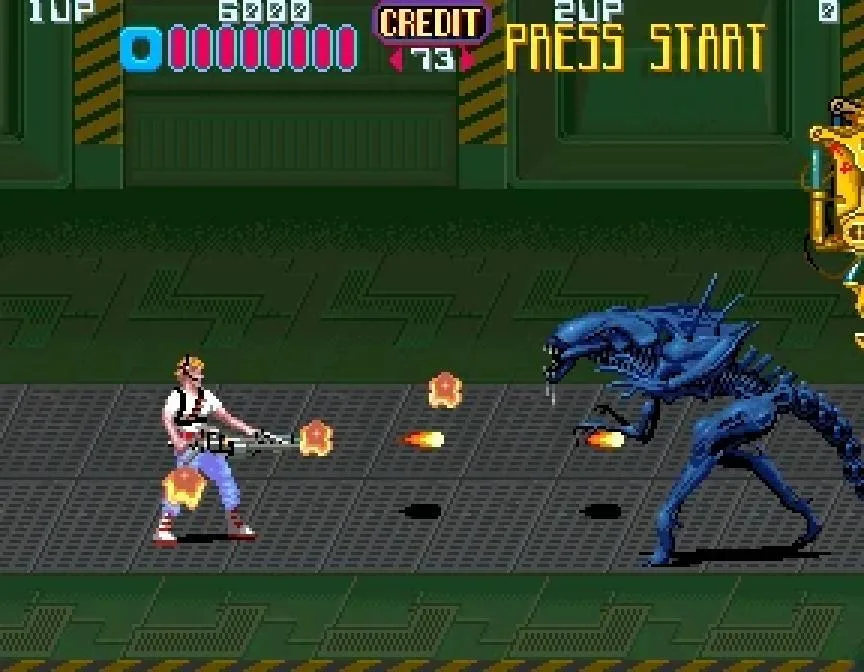
Konami's 1990 Aliens arcade game makes its priorities immediately clear. Readable enemies, responsive action, and a steady supply of threats turn the franchise into an energetic combat spectacle. The creatures are meant to be fought rather than preserved as unknowable presences.
It is a reasonable interpretation of Cameron's contribution to the series. The difficulty is that action games frequently make the enemy more understandable than the film does. Repetition teaches players which movements and attacks are safe. Familiarity becomes power.
That can create a satisfying game while gradually replacing fear with confidence.
The 1990s: one license, many kinds of firefight
The console adaptations of Alien 3 demonstrate how far licensed games could move from a film's exact events. Different versions organize rescue objectives, weapons, routes, and time pressure around their own platform requirements.
The resulting action is not a literal reproduction of the movie's vulnerability. It is a practical construction of things a player can learn and repeat. Comparing versions is therefore more useful than assuming one cartridge explains all the others.
Alien³: The Gun takes the arcade route more literally, placing the emphasis on aiming, reacting, and surviving a controlled sequence of attacks. The film's creature becomes a target that needs to be immediately visible and readable.
Alien Trilogy later uses the language of first-person shooting to combine recognizable franchise material into a new action experience. Alien Resurrection offers another important first-person interpretation, including a control arrangement that looks more familiar to modern console players than some contemporary reactions suggested.
The distinction is worth preserving without declaring any one title the undisputed inventor of modern controls. A feature can be forward-looking without requiring a simplistic “first ever” claim.
Across these games, the Xenomorph remains wonderfully useful. It can move quickly, emerge from darkness, attack in numbers, and make a corridor feel active. Those qualities support excellent combat situations. They do not automatically preserve the original film's sense of being fundamentally outmatched.
Alien vs. Predator changes who has the advantage
The crossover games make the question of player identity explicit. A human, an Alien, and a Predator do not need to experience the same location in the same way.
The SNES game and Capcom's 1994 arcade interpretation use recognizable creatures inside different kinds of side-scrolling combat. The Atari Jaguar game, and later the PC Aliens versus Predator titles, develop a more pronounced difference between playable species.
For the marine, sound and limited awareness can make an ordinary route frightening. For a Predator, equipment and concealment encourage a hunt. For an Alien, movement and proximity change which surfaces and approaches feel useful.
That is one of the franchise's strongest contributions to games. Fear is not simply a property of a monster model. It depends on what the player can perceive, reach, resist, and escape.
Changing those abilities can make the same space feel like three different worlds. We will return to that idea from the hunter's side in Part 9 — Predator (Coming October 30, 2026).
Colonial Marines and the burden of expectation
Aliens: Colonial Marines arrived in 2013 with a premise that seemed almost designed to attract anticipation: return to the familiar world of armed marines and hostile extraterrestrials with modern hardware.
Its disappointing reception became part of the franchise's gaming history. The useful lesson is broader than any single widely repeated story about its development. A recognizable setting and a promise of authenticity do not guarantee convincing encounters.
Enemies have to create the pressure the presentation suggests. Teammates, routes, and objectives have to contribute to the sense of a mission going wrong. If those systems feel unreliable for the wrong reasons, the experience stops resembling desperate survival and starts resembling software that needs correcting.
The franchise needed another answer. In 2014, Alien: Isolation supplied a particularly forceful one.
Isolation: being underprepared becomes the whole game
2014 · Creative Assembly / Sega
Alien: Isolation follows Amanda Ripley into the Sevastopol station, where the search for information about her mother becomes a struggle to survive. Its most important decision is to make the protagonist meaningfully vulnerable.
The Alien is not simply another enemy in a long queue. It changes how the player moves through a space, when they stop, which sounds they make, and how carefully they interpret a possible escape.
Creative Assembly's stated aim was to return to the original film's survival-horror values with an underprepared character facing overwhelming odds. The finished game's effect depends on carrying that idea into ordinary actions.
Opening a door takes on significance when something may be on the other side. Completing a task becomes difficult because attention is divided between the interface and the room around it. Waiting is an action with risks of its own.
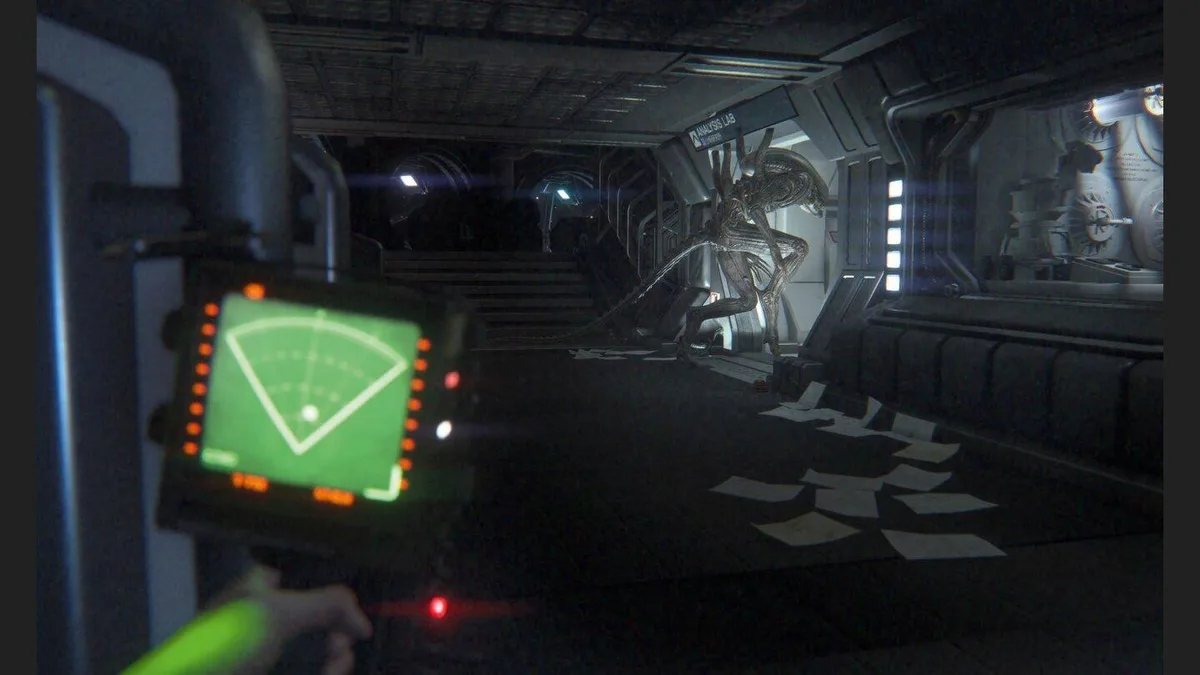
The tracker does not solve the problem
A motion tracker provides incomplete information rather than certainty. It helps establish proximity, but proximity is not the same as a complete understanding of the creature's next move.
That is an important distinction. A tool that reveals everything can turn fear into straightforward route planning. A tool that reveals enough to make the player anxious can deepen the experience.
Hiding is similarly conditional. A refuge is useful without becoming a universal pause button. The player has to consider how they arrived, what attracted attention, and whether remaining in one place is still sensible.
The resulting tension does not require a claim that the Alien possesses unlimited intelligence or that every moment is completely unscripted. Designed systems can create uncertainty without being magical. What matters is that the player cannot reduce every encounter to an immediately reliable sequence.
A flamethrower can buy time without buying victory
Giving the player a powerful defensive tool could destroy that balance. Isolation instead makes resistance part of the resource problem.
A temporary reprieve can be useful while still leaving the main threat intact. Fuel, opportunity, and the consequences of drawing attention prevent the weapon from becoming a permanent solution to every corridor.
This is a strong adaptation of the film's imbalance. The player can act, prepare, and improve their chances without transforming into an unstoppable monster hunter.
It also keeps learning valuable. Fear does not require total helplessness. It can emerge from knowing several useful responses and realizing none is guaranteed to remain available.
Sevastopol looks like the future imagined in 1979
The station's practical interfaces, industrial detail, and restrained technological vocabulary help make it belong to the original film's world. The important achievement is consistency rather than novelty.
Audio reinforces that consistency. Mechanical noises, distant movement, alarms, and the tracker's information compete for attention. The player is continually deciding which sound belongs to the station and which might indicate a threat.
The environment therefore does more than establish a recognizable aesthetic. It supplies the incomplete evidence on which survival decisions depend.
That is why Isolation remains central to this retrospective. It does not just reproduce the Alien. It gives ordinary movement and attention the emotional weight the film gave them.
The later branches: phones, squads, and headsets
The series continued to explore other structures rather than treating Isolation as the only acceptable model.
- Alien: Blackout (2019): a mobile interpretation built around monitoring and directing others under threat, rather than a miniature conventional shooter.
- Aliens: Fireteam Elite (2021): cooperative combat, emphasizing roles, equipment, and the pressure of fighting together.
- Aliens: Dark Descent (2023): squad-based tactics that make stress, positioning, and the consequences of command part of the experience.
- Alien: Rogue Incursion VR (2024): an action-horror approach in virtual reality, with physical interaction changing how equipment and threats are experienced.
These are not interchangeable substitutes. A tactical command and a physical reload create different relationships with danger. Their value comes partly from finding something the source material can express particularly well through their chosen format.
A sequel is announced, not already released
Sega and Creative Assembly formally announced Alien: Isolation 2 on June 8, 2026. The announcement describes another hostile setting and lists modern platforms, but its product information gives the release date as TBD.
That is an important boundary for a historical feature published in October 2026. An announced sequel belongs in the story; an invented launch date or a review of a finished game does not.
The encouraging part is the continuation of an idea the series spent decades circling: a vulnerable person, a hostile environment, and a creature whose presence changes the meaning of every route through it.
Whether the sequel achieves that remains a question for the released game.
The best Alien game knows what kind of power to deny
The franchise's range is its strength. Arcade combat, tactical command, species-based multiplayer, and solitary survival can all make sense inside its universe.
What distinguishes Isolation is the precision of its relationship with the original film. The player has enough agency to remain responsible for survival, but not enough power to make the situation ordinary.
A corridor can be familiar without becoming safe. A weapon can be useful without ending the threat. A tracker can help without delivering reassurance.
That is a demanding balance, and it is why the franchise's quieter interpretations deserve as much attention as its loudest firefights. Sometimes the most frightening thing a game can give you is accurate information about how little time you have left to decide.
Previously: Part 6 — The Evil Dead. Next: Part 8 — The Thing (Coming October 29, 2026).
Sources and image credits
- Creative Assembly's original Isolation interview: the return to vulnerability and the original film's design values.
- Focus and Tindalos on Dark Descent: the 2023 squad-based interpretation.
- Survios's Rogue Incursion VR listing: the original VR edition, developer, and December 2024 release.
- Sega's June 2026 sequel announcement: the announced sequel and explicitly unconfirmed release date.
Selected milestones are discussed rather than every port, expansion, and guest appearance. Supplied images retain their credited source labels in the captions; rights remain with their respective owners.
Keep the horror playing
Listen after dark
If you’d like to keep the atmosphere going, here’s Under The Covers: 12 Nights of Horror—my arrangements of themes from Halloween, Friday the 13th, Jaws, The Exorcist, Silent Hill, and more.