Horror at the Controls: Part 10 — The Exorcist
- Horror at the Controls
- Horror films
- Horror games
- Atari
- Jaws
- Friday the 13th
- A Nightmare on Elm Street
- The Evil Dead
· Aaron Lehnen · 10 min read
Possession, virtual reality, and a game that survived under another name.
A frightening noise comes from behind you. On a television, turning toward it means moving a camera. In virtual reality, it means turning your own head.
The difference sounds small until you do not want to look.
That is a fitting place to finish Horror at the Controls. Across this series, games have asked us to hunt monsters, become them, rescue other people, command a squad, and decide whom to trust. The Exorcist presents a different challenge: make an encounter with something beyond the protagonist's control feel physically immediate, without simply turning a ritual into another shooting mechanic.
Its best-known game adaptation also supplies an unexpected ending to our recurring preservation story. Instead of only disappearing with its license, it continued under a different identity.
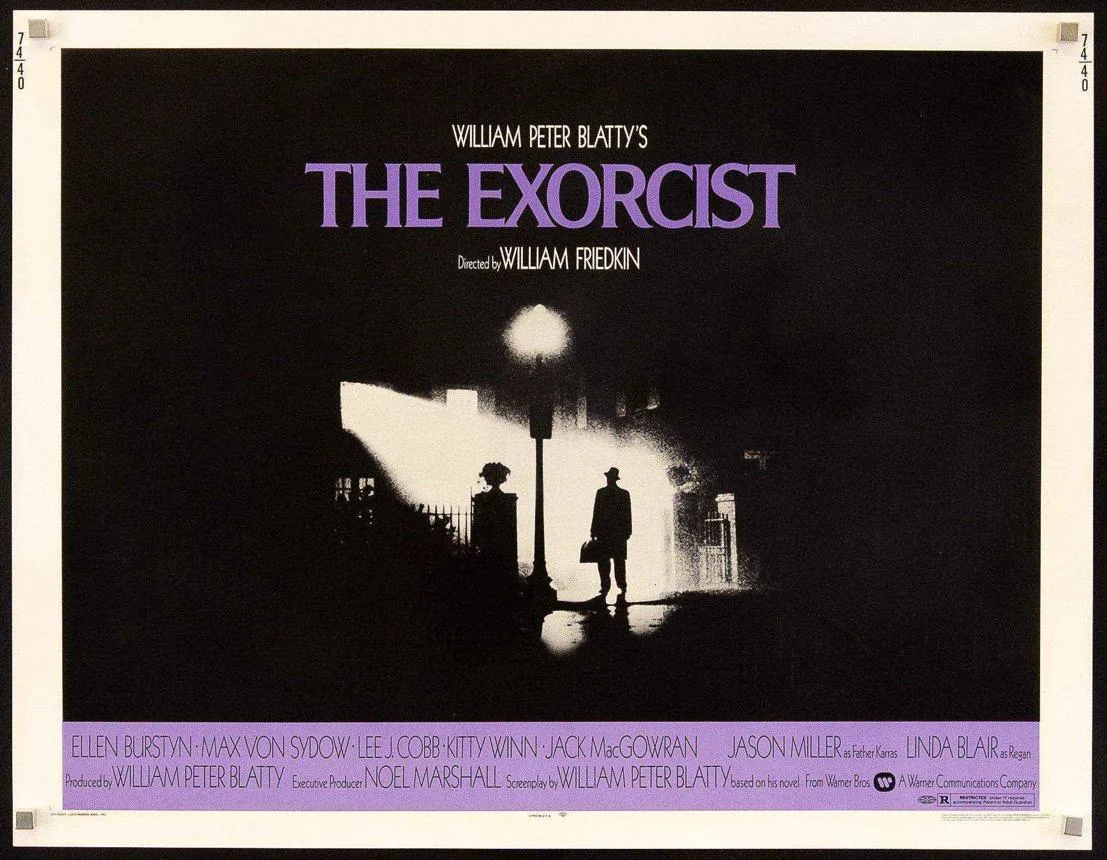
A bedroom becomes somewhere nobody understands
William Friedkin's 1973 adaptation of William Peter Blatty's novel makes a familiar domestic setting the center of a frightening conflict. The people trying to help Regan confront events they cannot comfortably explain or control.
The horror depends on more than disturbing imagery. Concern for a vulnerable person, uncertainty about what is happening, and the limits of ordinary expertise give the confrontation weight. The central objective is rescue rather than simply destroying an enemy.
The film's association with Mike Oldfield's Tubular Bells also demonstrates the importance of context. A musical pattern can acquire a disturbing identity through the images and expectations attached to it. It does not need constant orchestral violence to suggest that something is wrong.
Stories about a supposedly cursed production belong to the film's surrounding folklore. They should not be presented as proof that supernatural events caused real incidents. The documented work and the legends told about it are different kinds of history.
For a game, the difficult material is the underlying conflict. What should a player actually do when the goal is helping a person while confronting a threat whose nature remains uncertain?
Why this is not an obvious action-game license
Some franchises arrive with immediately usable rules. The shark pursues swimmers. The Predator hunts with specialized equipment. The Xenomorph makes routes and hiding places dangerous.
The Exorcist does not offer the same ready-made combat loop. Giving the player a weapon and a sequence of ordinary enemies would change much of what makes the story distinctive.
Investigation offers a more natural starting point. Strange evidence, unfamiliar behavior, objects that matter for reasons the protagonist does not yet understand, and encounters that resist a normal explanation can all create activity without resolving the mystery immediately.
The ritual itself presents another challenge. If success becomes a routine damage calculation, the supernatural conflict can lose its character. If the actions are completely obscure, the player may feel confused rather than frightened.
The adaptation needs a comprehensible task inside an incomprehensible situation. Virtual reality gives that task another dimension: carrying it out can involve the player's own attention, orientation, and hands.
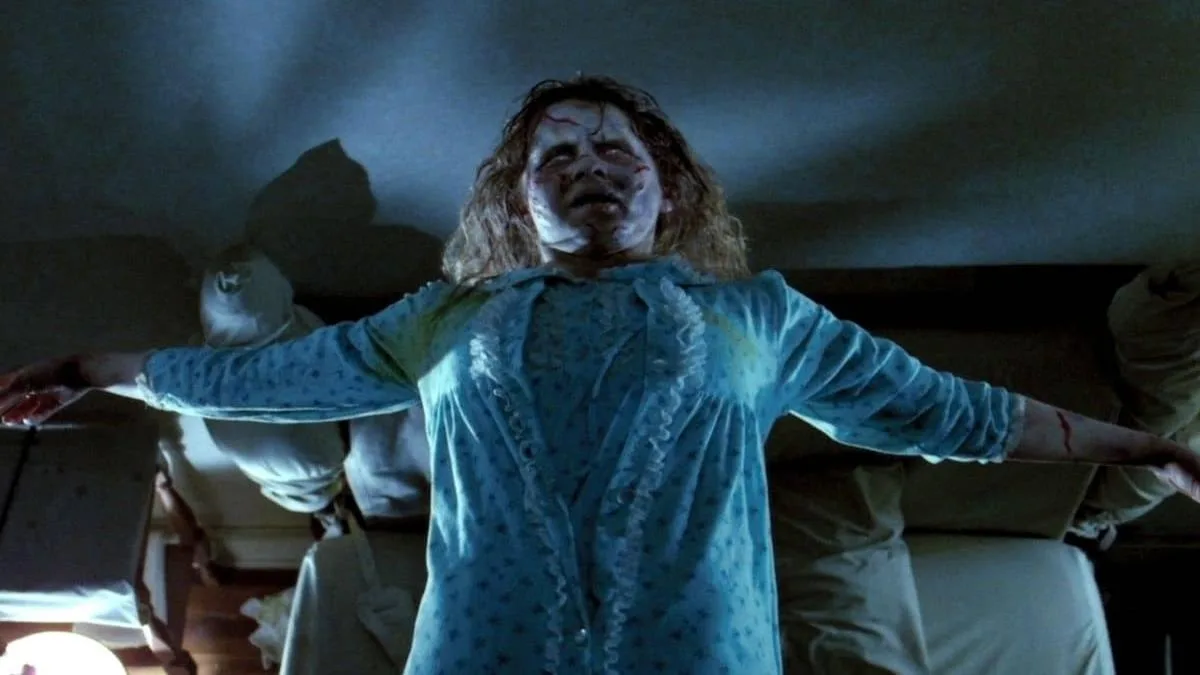
Legion VR: begin as an investigator
The Exorcist: Legion VR · Original episodic release, 2017–2018 · Wolf & Wood / Fun Train
The original VR adventure follows a detective into supernatural investigations rather than simply recreating the first film's bedroom scene. Its five initial chapters build a sequence of encounters within the licensed world.
That is a sensible adaptation decision. The familiar property establishes expectations, but a new investigator can discover events whose outcome the audience does not already know.
The opening investigation begins from a recognizable role: examine a disturbing incident and try to understand the evidence. As the supernatural becomes harder to dismiss, ordinary procedures stop being sufficient.
The shift matters. Handing the player extraordinary powers immediately might make the world feel manageable. Letting those powers become necessary during an investigation preserves the sense that the situation has exceeded what the protagonist originally expected.
The structure also lets locations and encounters develop distinct identities. A series of short investigations can vary its atmosphere without stretching one haunted room across an entire campaign.
A sequence of nightmares, not one long firefight
The original chapters move through different forms of confined, disturbing space before bringing the separate threads toward a final confrontation. Their value lies partly in how much can change between one investigation and the next.
A new room resets the player's assumptions. An object that would be reassuring elsewhere can become suspicious. An ordinary sound may be useful evidence or a deliberate attempt to redirect attention.
Short chapters are particularly effective for that kind of design. They give a scenario enough time to establish expectations, undermine them, and finish before the player has fully normalized its tricks.
There are limits. Compact episodes do not offer the extensive exploration, branching decisions, or long-term character progression of a much larger adventure. Scripted scares can also become less effective when repeated.
But length is not the only measure of success. An intense, focused encounter can suit this material better than several additional hours of routine combat inserted to make the package look substantial.
The question is whether each interaction contributes to the unease, rather than simply delaying the next event.
Your hands become part of the scene
Ritual objects change character in VR. Instead of pressing a button to watch a protagonist perform an action, the player has to position an object, look toward a threat, or manage an interaction while the environment is trying to distract them.
These are fictional horror mechanics, not instructions in actual religious practice. Their significance comes from how they organize attention and movement under pressure.
You may understand what an encounter requires and still hesitate to do it. A sudden sound makes you turn away. An approaching figure makes a simple hand movement feel less reliable. The task is mechanically comprehensible while the situation makes carrying it out uncomfortable.
That is a useful form of vulnerability. The game does not have to remove every means of response. It can give you a response and make you responsible for performing it while frightened.
VR also changes the scale of an ordinary room. A nearby object can feel close enough to reach, and an apparently empty area behind the player can become something they are physically reluctant to check.
The horror emerges from the relationship between representation and response. Nothing has to leave the fictional world for the player's body to become part of how it is experienced.
Listening is an activity
Spatial sound is especially valuable in this setting. A noise can establish direction without revealing its source, making the player decide where to look and what to leave outside their view.
That makes silence useful too. A continuous loud score would occupy attention while also making every moment feel similarly urgent. Quieter stretches leave room for the player to anticipate a change.
The point is not that music should disappear from horror. It is that sound can organize uncertainty more precisely than a permanent instruction to feel frightened.
A voice from an adjoining space suggests a presence. A disturbance behind the player demands a decision. A familiar mechanical sound can temporarily reassure—or become disturbing once its context changes.
The game therefore turns listening into part of exploration. It is not merely decorating a room that would otherwise work in exactly the same way without audio.
This is one of the clearest connections between the series' film history and the possibilities of interactive design. In a film, the director decides when to show the source of a sound. In a game, the player may have to choose whether they want to see it.
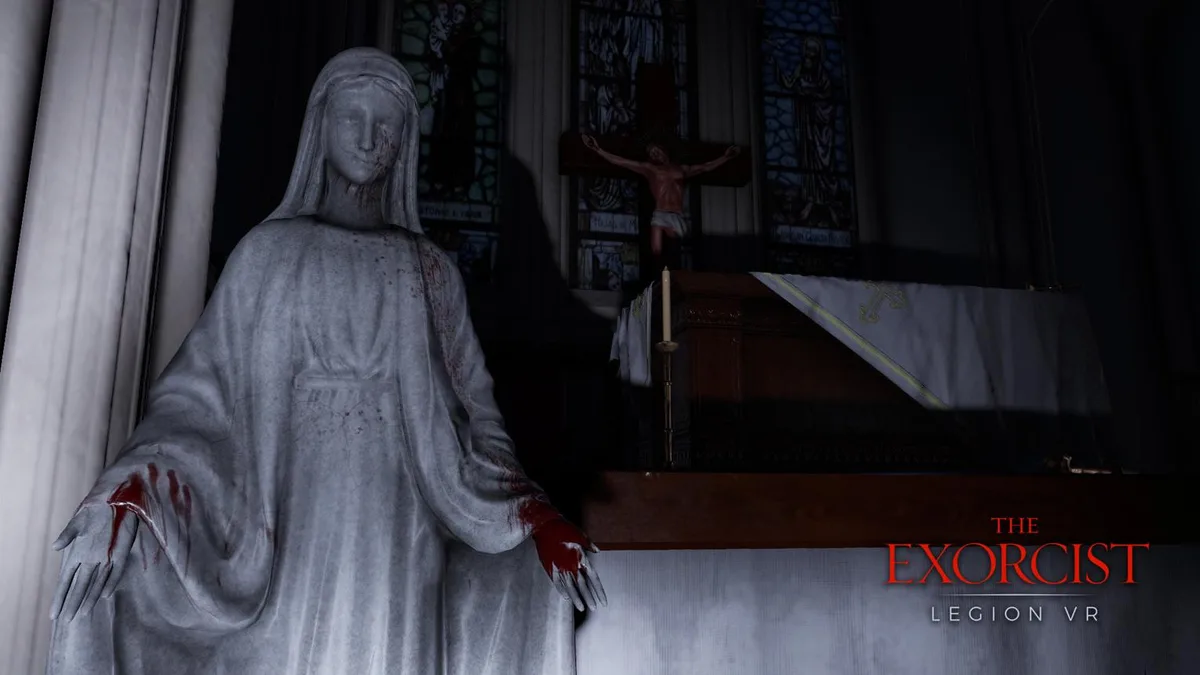
New headsets, new versions of the same encounter
The adventure's later platform releases and upgraded editions show why preservation in VR can require active work. A headset is not only a display. Its tracking, controllers, performance, and supported interaction methods help determine what the game actually feels like.
Moving an experience to newer hardware can therefore mean more than increasing a resolution setting. An interaction that was usable on one system may need adjustment on another, while improved clarity or tracking can make the same scene feel substantially different.
That makes continued availability valuable without implying that every edition is identical. Platform-specific descriptions and supported hardware still matter.
The Steam collection's listed date, for example, should not be mistaken for the first appearance of the original episodic project. A later collected edition and an earlier chapter release are separate milestones in the same history.
SIN: an announced sequel placed on hold
The planned Legion VR SIN project aimed toward another form of supernatural horror, including a cooperative direction suggested by its Safety in Numbers subtitle.
That premise offers interesting possibilities. Companions can disagree about an observation, notice different details, or need help at a moment when helping creates risk. Those possibilities should be distinguished from confirmed mechanics in a finished game.
Fun Train's August 2025 announcement placed SIN on indefinite hold, citing the commercial difficulty of a large premium VR project. The studio left open a possible future return rather than announcing a completed release.
That is the boundary a retrospective needs to respect. The proposed sequel belongs in the history of the franchise's gaming ambitions. It should not be reviewed as something players can already experience, or described as definitely canceled forever when the announcement used a different formulation.
2026: Exorcism of the Legion, Last Rites
By 2026, the earlier licensed game had acquired a new identity: Exorcism of the Legion (Last Rites). Its current storefront explicitly describes it as independent of The Exorcist film and literary properties.
That distinction should remain visible even in an article tracing its earlier licensed history. The previous association explains why the game belongs in this series. It does not make its current edition an officially affiliated Exorcist product.
The current Steam description also includes a sixth chapter, an epilogue. The five-chapter original and the later expanded collection should therefore not be described as the same package with only its title changed.
This is a more complicated preservation outcome than a simple disappearance. A work can continue while aspects of its identity and contents change. Understanding that continuity requires keeping track of which version a description concerns.
It also closes one of our recurring themes. Licensed games are shaped not only by hardware and creative choices, but by commercial arrangements that may change after the code has already been written.
A monster can remain recognizable for decades. A particular game about it may have a much less stable public identity.
Ten films' worlds, ten different responsibilities
The strongest adaptations in this series do more than reproduce a famous face. They make the player responsible for something that belongs to the source's particular kind of fear.
| Part | Franchise | The pressure handed to the player |
|---|---|---|
| 1 | Jaws | Prepare for the predator—or become it |
| 2 | Friday the 13th | Protect people when you cannot watch everywhere |
| 3 | A Nightmare on Elm Street | Trade wakefulness for dangerous power |
| 4 | Halloween | Notice the threat before someone else needs rescuing |
| 5 | The Texas Chain Saw Massacre | Escape a place its hostile residents understand |
| 6 | The Evil Dead | Recover control as panic becomes slapstick |
| 7 | Alien | Act on useful information that cannot make you safe |
| 8 | The Thing | Depend on people you have reasons to distrust |
| 9 | Predator | Understand how the other side sees the same world |
| 10 | The Exorcist | Carry out a task while afraid to look toward it |
Across these approaches, technology changes what can be represented, but design decides what the player has to care about. A handful of Atari figures can communicate rescue. A VR room can make turning around feel like a serious commitment.
The most memorable moment is often the point at which a familiar movie situation stops being something you can criticize from the sofa. You need to choose a route, trust a companion, stay awake, hold an object steady, or decide whether a noise is worth investigating.
Then the next sound arrives, and the comfortable plan becomes a little less convincing.
That is where the controller earns its place in the horror story.
Previously: Part 9 — Predator. Return to Part 1 — Jaws to revisit the complete countdown.
Sources and image credits
- Fun Train's original Legion VR announcement: the original developer, licensed episodic identity, and platform expansion.
- Fun Train's SIN announcement: the indefinite hold and stated commercial reasoning.
- The current publisher storefront: the revised title, independent-property notice, sixth chapter, and collected-edition details.
- Fun Train's current product terms: the revised identity in the publisher's own records.
Images were supplied with the draft. Historical Legion VR imagery is labeled as such and does not imply that the current independent edition remains an affiliated Exorcist product. Rights remain with the respective owners. Film and game spoilers are discussed throughout.
Keep the horror playing
Listen after dark
If you’d like to keep the atmosphere going, here’s Under The Covers: 12 Nights of Horror—my arrangements of themes from Halloween, Friday the 13th, Jaws, The Exorcist, Silent Hill, and more.